

2026 World Cup Betting: Where AI Finds Value in the First 48-Team Tournament

The most wide-open World Cup ever created
Every World Cup arrives with the same tidy story. A few favorites, a couple of dark horses, and one or two names casual bettors latch onto because the narrative is easy. This summer the favorites are Spain and France, both sitting around +500. England follows, then Argentina and Brazil.
But the 2026 World Cup is genuinely different, and not just because of the names at the top. For the first time, 48 nations compete across 12 groups of four, up from the traditional 32-team, 8-group format. That expansion produces 104 total matches and a Round of 32 that didn't exist before, with the top two teams from each group plus the eight best third-place finishers advancing.
More teams, more matches, and more balanced groups mean more variance. From a betting standpoint, variance is opportunity. The expanded field creates dozens of group-stage matchups where the sportsbook line reflects public sentiment more than actual probability, and those are exactly the spots a data-driven approach is built to find.
What Spain and France at +500 actually tells you
Spain opened as the solo favorite at +450 after the December group draw. Then Lamine Yamal picked up a hamstring injury in a Barcelona match, and the market moved. Spain drifted to +500, France climbed from +550 to match them, and the two now share favorite status heading into the summer.
The detail that matters: Yamal is expected to be available for the tournament. So the market is pricing Spain's matches with a question mark that may not reflect his actual status. Before the injury news, BetMGM reported Spain held an enormous share of the handle to win its group. When a team's true win probability holds steady but the line drifts on narrative noise, value opens up on that team's match lines. That gap between perception and probability is the entire game.
France at +500 makes sense on paper. Kylian Mbappé leads one of the deepest rosters in the tournament, and France landed in Group I alongside Senegal, Norway, and Iraq. That sets up a France vs Norway group match, and with Erling Haaland leading Norway, the storyline will dominate coverage for weeks. Coverage drives handle. Handle moves lines. Whether those lines reflect real match probability or just a compelling narrative is precisely what the models are built to separate.
The host nation groups are where the public gets it wrong
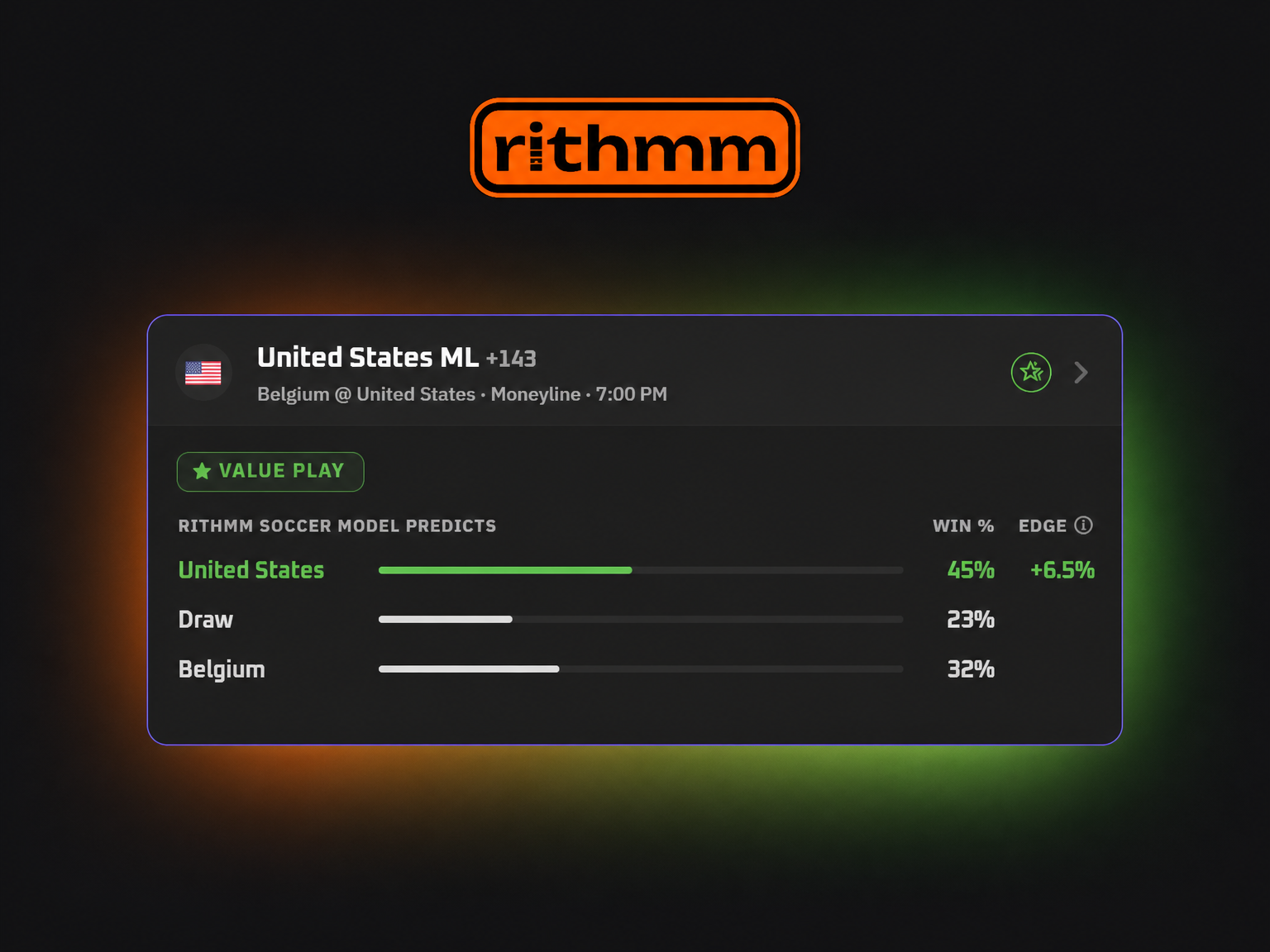
Here's the dynamic most casual bettors miss. The United States, Mexico, and Canada were each placed into specific groups as hosts, independent of their world ranking. In a normal draw, group seeding tracks the strongest teams in the world. In 2026, for the hosts, it tracks geography.
The result is that the host groups are among the more balanced in the field. The United States sits in Group D with Paraguay, Australia, and Türkiye, and opens against Paraguay in Los Angeles on June 12, with home crowds unlike anything most of the squad has played in front of. Türkiye's attacking quality and Paraguay's defensive discipline make this far from a free pass. Mexico headlines Group A against South Africa, South Korea, and Czechia, opening the entire tournament on June 11 in Mexico City. Canada anchors Group B alongside Switzerland, Qatar, and Bosnia and Herzegovina.
In a 3-way moneyline market, balanced matchups mean the draw and the underdog carry real value. Books know the home crowd drives enormous betting volume onto the host nations, so the lines shade to absorb that action. The models look at squad quality, recent form, tactical style, and how teams have performed in similar situations. When public money and the underlying data diverge, that's where the value lives.
Why the group stage is the smartest place to bet
The single biggest mistake World Cup bettors make is loading up on a handful of big outcomes, a tournament winner, a golden boot, and then waiting weeks to see how they land. With 104 matches, the 3-way moneyline and totals markets give you a structured, match-by-match process every single day of the tournament instead.
Two patterns make the group stage especially rich. The first is that 3-way moneylines reward the draw. International soccer produces draws at a meaningful rate, especially in group-stage matches where both teams are managing qualification scenarios and neither wants to lose. When the public piles onto one side, the books shade the line, and the draw quietly becomes underpriced relative to how often it actually happens. The second is that totals get priced cautiously early. Books set conservative numbers on early group matches, when tournament form is still thin and teams are feeling each other out. Two organized sides playing a tense opener with everything to lose tend to play differently than they would in a midseason club match, and those tactical tendencies show up as repeatable signals in the over/under market.
Neither of these requires betting on a champion six weeks out. They show up in individual match lines, one game at a time, across all 104 matches.
Rithmm's World Cup Beta is coming
This is where our newest release comes in. Ahead of the June 11 kickoff, Rithmm is rolling out a World Cup Beta that brings the models to two of the tournament's most valuable bet types: 3-way moneyline and totals predictions. As the tournament approaches, the models will run projections across the group stage and into the knockout rounds, surfacing the matches where the data and the market disagree most.
Here's the part worth acting on now: the same models powering the World Cup Beta already run every day across MLB, the NBA, the WNBA, and PGA golf. You don't have to wait for the opening whistle to put a data-driven process to work. There are dozens of games on the board tonight, and the models are reading all of them.
So start now. Download the Rithmm app, begin your 7-day free trial, and get comfortable with how the models work across the sports already in season. Then, when the World Cup Beta goes live in early June, you'll be ready to put it to work from the first match.
Odds accurate as of publication and subject to change. Rithmm provides data-driven predictions for entertainment and informational purposes.