

World Cup 2026 Upsets: Germany and the Netherlands Are Out, and What the Models See for Today
The Round of 32 Just Rewrote the Script
Nobody expected the 2026 World Cup to open its knockout stage like this. Germany, a four-time world champion that most brackets had penciled into the later rounds, is gone. The Netherlands, built around one of the most lethal attacking lineups in Europe, are gone. Both went out in penalty shootouts within hours of each other, and the soccer world is still catching its breath.
Paraguay beat Germany 1-1 through 120 minutes before converting 4-3 in the shootout, with Kai Havertz, Nick Woltemade, and Jonathan Tah all missing crucial penalties. Morocco did the same to the Netherlands in what became the earliest World Cup exit in Dutch history. Neither result was a fluke. Both teams were widely expected to advance, and both are going home.
What these results reveal is something that predictive models have understood for years: in knockout soccer, form, reputation, and market pricing only tell part of the story. The variance in a single-game, penalty-inclusive format is enormous, and the teams that survive are not always the best teams on paper. They are the teams built for exactly this format.
Why Upsets Like These Keep Happening
The conventional approach to betting a tournament like this is to follow the market. Germany was priced as a favorite over Paraguay. The Netherlands were favored against Morocco. The implication is that the market has done its homework and the numbers reflect the true probability of each outcome.
But World Cup knockout margins are razor thin. A single missed penalty, one moment of defensive miscommunication, or a goalkeeper who finds his best form at the right time can flip an outcome that the market priced at 25% into a reality. When you layer penalty shootout variance on top of 120 minutes of soccer, even a team playing at 70% of their expected quality can win.
This is exactly where predictive models find the most value. Rather than anchoring to reputation or public expectation, the models weigh the actual evidence in front of them: current form, defensive structure, set piece threat, and how each team performs when a match is forced into extended pressure. The result is a cleaner read on where the real probability sits versus where the market has priced it.
What Rithmm's Models Are Flagging for Today
With Germany and the Netherlands out and the Round of 32 continuing today, Tuesday's slate brings two matches where the models are seeing clear signals.
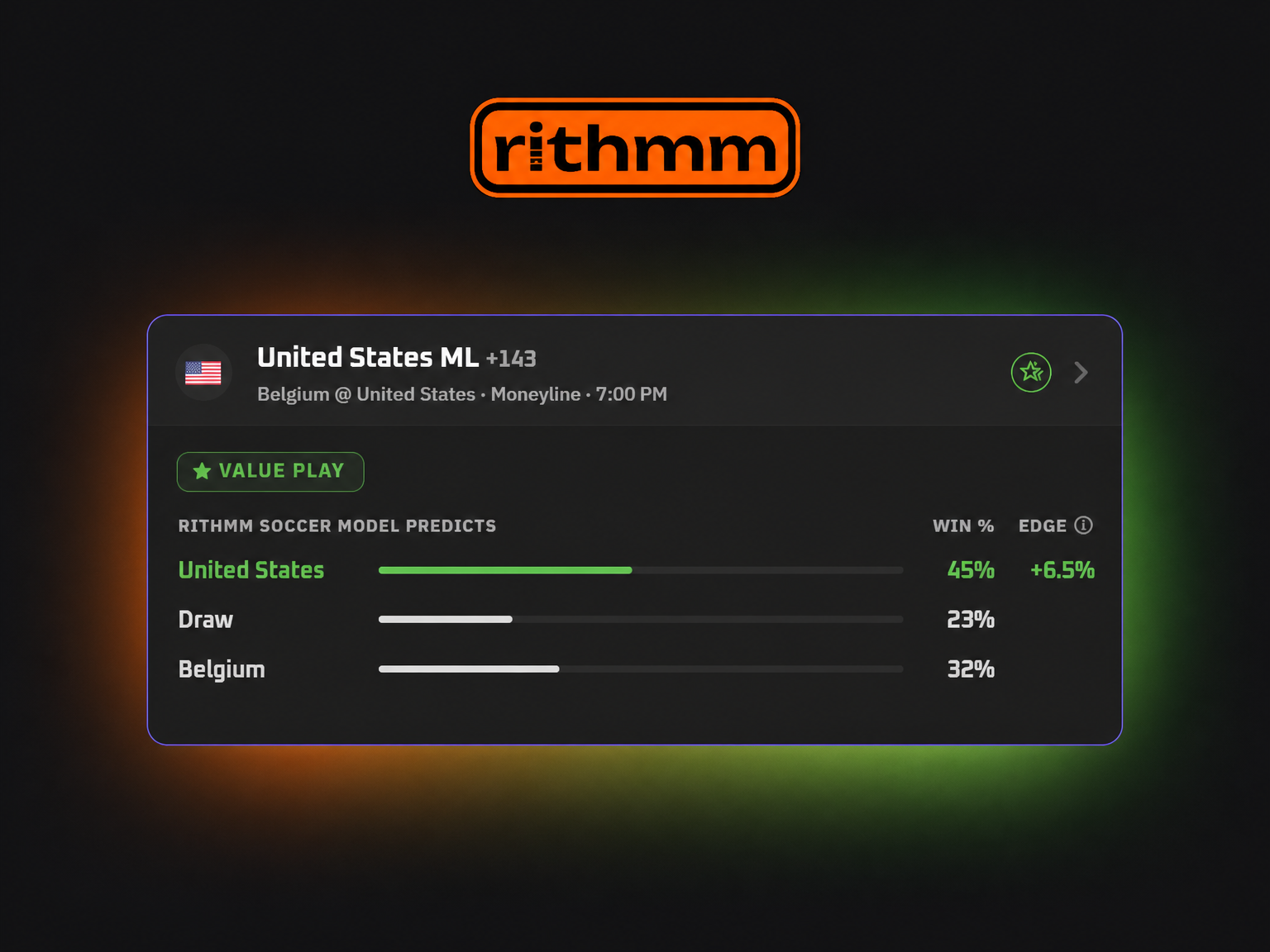
The first is Côte d'Ivoire versus Norway at AT&T Stadium in Arlington, Texas, with kickoff at 1 PM ET. Norway enters as the market favorite, priced around -130 to -140 at most books. The models disagree. Rithmm's soccer models give Côte d'Ivoire a 32.5% win probability and are flagging a 14.5% positive edge on the moneyline at +252. That combination, a meaningful win probability paired with odds the market has underpriced, is exactly the kind of signal that gets marked as a Value Pick in the app. The models are not saying Côte d'Ivoire wins this easily. They are saying the price at +252 is offering significantly more value than the actual probability of that outcome warrants.
The second match is France versus Sweden at MetLife Stadium at 5 PM ET. This one reads differently. The models give France an 82.7% win probability and see a 5.9% edge even at odds of -356. When a heavy favorite is still showing positive edge at a short price, it is a signal that the true gap between the two teams is wider than the line reflects. Sweden qualified from a group that allowed it, but France at full strength in a knockout game is a different proposition entirely, and the models back that confidence with the numbers to support it.
What to Do With This Information
The Germany and Netherlands exits are a reminder that betting the obvious favorite in a World Cup knockout match is not a strategy. It is a habit. The teams the market loves are also the teams where you pay the steepest price for the lowest edge.
What the models do is separate those two things. You can find a market favorite where the edge is still real, like France today. And you can find an underdog where the public has overcorrected and left genuine value on the table, like Côte d'Ivoire at +252. Both are valid plays because both are grounded in the same thing: a model probability that disagrees with what the sportsbook line implies.
The World Cup is not over for the favorites who remain. Brazil survived Japan in an uncomfortable performance. The USA, into the knockout rounds as a group winner, still has the quarterfinal run the country has been building toward for three years in front of it. But the chaos of the last 48 hours makes one thing clear: this tournament will not be decided by name recognition. It will be decided by data, matchup fit, and who shows up when it matters.
Rithmm's models are tracking every remaining match in the Round of 32 and beyond. If you want to see the full breakdown on today's slate, including win probabilities, edge, and what the models are flagging as the real value plays, download the app and check the Soccer tab before kickoff.