

2026 World Cup Betting: What AI Predictions Are Showing Through the Tournament
Why the World Cup Is Harder to Model Than Any Other Sport
Most AI sports betting tools are built on one thing: repetition. Seasons give models the data density they need. An NBA team plays 82 games. An MLB pitcher takes the mound 30 times. A pattern that shows up across hundreds of data points becomes something you can model with confidence.
The World Cup breaks all of that. It happens once every four years. Squads change. Managers change. The matchups are largely unfamiliar. The historical sample for any given head-to-head is thin, and in many cases does not exist at all. There is no recurring season to draw from. No comfort of a deep stat library. Just one shot at each match, in a tournament format, against opponents that most modeling systems have never seen play each other at this level.
That is precisely why launching a World Cup product was as much an R&D milestone as it was a product release. The core question was not whether our models could perform on familiar territory. We already knew that. The question was whether the modeling engine could generalize — whether it could find signal in a one-off event with limited historical precedent.
What the Numbers Are Showing So Far
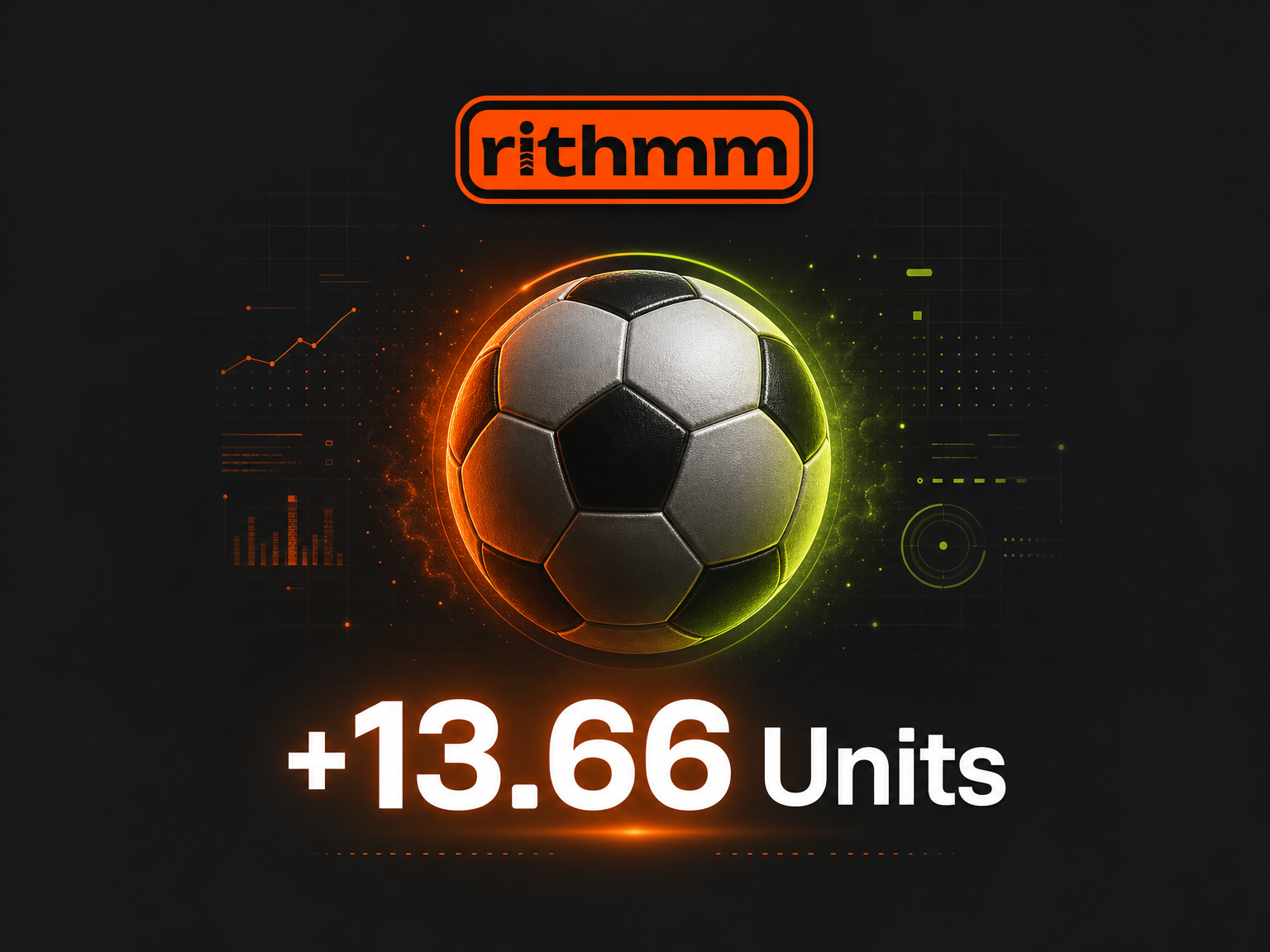
Through July 7, Rithmm's models are +13.66 units against the closing line across the 2026 World Cup. That benchmark matters. Closing line value is the most rigorous measure of whether a model is genuinely identifying edge rather than getting lucky on outcomes. It asks a simple question: are the models consistently finding bets where the final market price confirms the value was there from the start?
On moneylines, the record is 19-19 at +8.21 units. Totals are 16-10 at +5.45 units. Both bet types are performing positively in an environment most AI sports betting tools would not have attempted at all.
What a 19-19 Record Actually Tells You
The moneyline record deserves a closer look, because a 50% hit rate sounds unremarkable on its surface. In sports betting, it is not. A 19-19 record generating +8.21 units of profit only happens one way: the models are winning at better prices than they are losing. The wins are coming on undervalued sides. The losses are coming on bets where the market had already priced the outcome more accurately.
This is what closing line value measures in practice. A model that simply picks favorites will post a better win rate but negative or flat returns. A model that finds undervalued sides will win roughly half its bets and still produce meaningful profit. The 19-19 record is not a weakness in the data. It is evidence of what the models are actually doing.
What This Means for AI Sports Betting Going Forward
The practical implication is straightforward. If the models can find edge at the World Cup — a once-every-four-years tournament with unfamiliar matchups, thin historical data, and no seasonal precedent — they can operate across a much broader range of events than traditional league play alone.
Sports betting is moving toward more event-based markets. International competitions, one-off tournaments, and non-traditional formats are growing in both volume and bettor interest. The tools that will matter in that environment are the ones that generalize, not the ones that only work when the data is comfortable.
The 2026 World Cup is still running. There is more data to come. But what the models have shown through the first weeks of the tournament meaningfully expands the universe of what Rithmm can model going forward — and that is the part of this we are most focused on.
We built Rithmm to give everyday bettors access to the kind of data-driven decision-making that used to belong exclusively to syndicates and sharp shops. Proving that the models work across formats is part of delivering on that promise.