

AI World Cup Picks 2026: How Predictive Models Find Value in the FIFA World Cup

What “AI World Cup Predictions” Usually Means
The 2026 FIFA World Cup is here. Forty-eight teams, 104 matches, five weeks of the biggest sporting event on the planet, and every bettor, group chat, and sports media outlet is asking the same question: who do the AI models like?
It’s a fair question. But there’s a version of that question that gets you a trivia answer, and there’s a version that gets you actual betting value. Understanding the difference is where the real value lives.
Search for World Cup AI predictions right now and you’ll find articles from every major sports outlet asking ChatGPT and Gemini to pick every match. They’re fun reads. Spain wins, France is right there, Brazil is dangerous. You’ll get confident-sounding bracket projections that read like a press release from FIFA itself.
Here’s the problem. General-purpose AI chatbots are trained on everything: Wikipedia, news articles, Reddit debates, soccer forums. When you ask one to predict the World Cup, it reflects the consensus. It gives you what everyone already knows, dressed up in precise-sounding language.
That’s not the same as finding value in a betting line.
A sportsbook has already priced in Spain’s Lamine Yamal, France’s depth, Argentina’s tournament pedigree. The line is set based on everything the market knows. Getting a chatbot to confirm Spain is talented doesn’t tell you whether the line on Spain as a heavy group stage favorite is worth betting. Those are two completely different questions.
What AI Models Actually Need to Do for Betting
Useful World Cup predictions require a different kind of AI work. The goal is finding the gap between what the market prices and what the data shows, not confirming who the better team is on paper.
That means looking at things like historical performance patterns for specific match conditions, how teams perform as heavy favorites versus close lines, scoring tendencies in group stage matches versus knockout rounds, and how the sportsbook has historically priced certain types of international matchups.
This is the difference between a prediction and a pick. A prediction tells you who wins. A pick tells you where the market is mispriced.
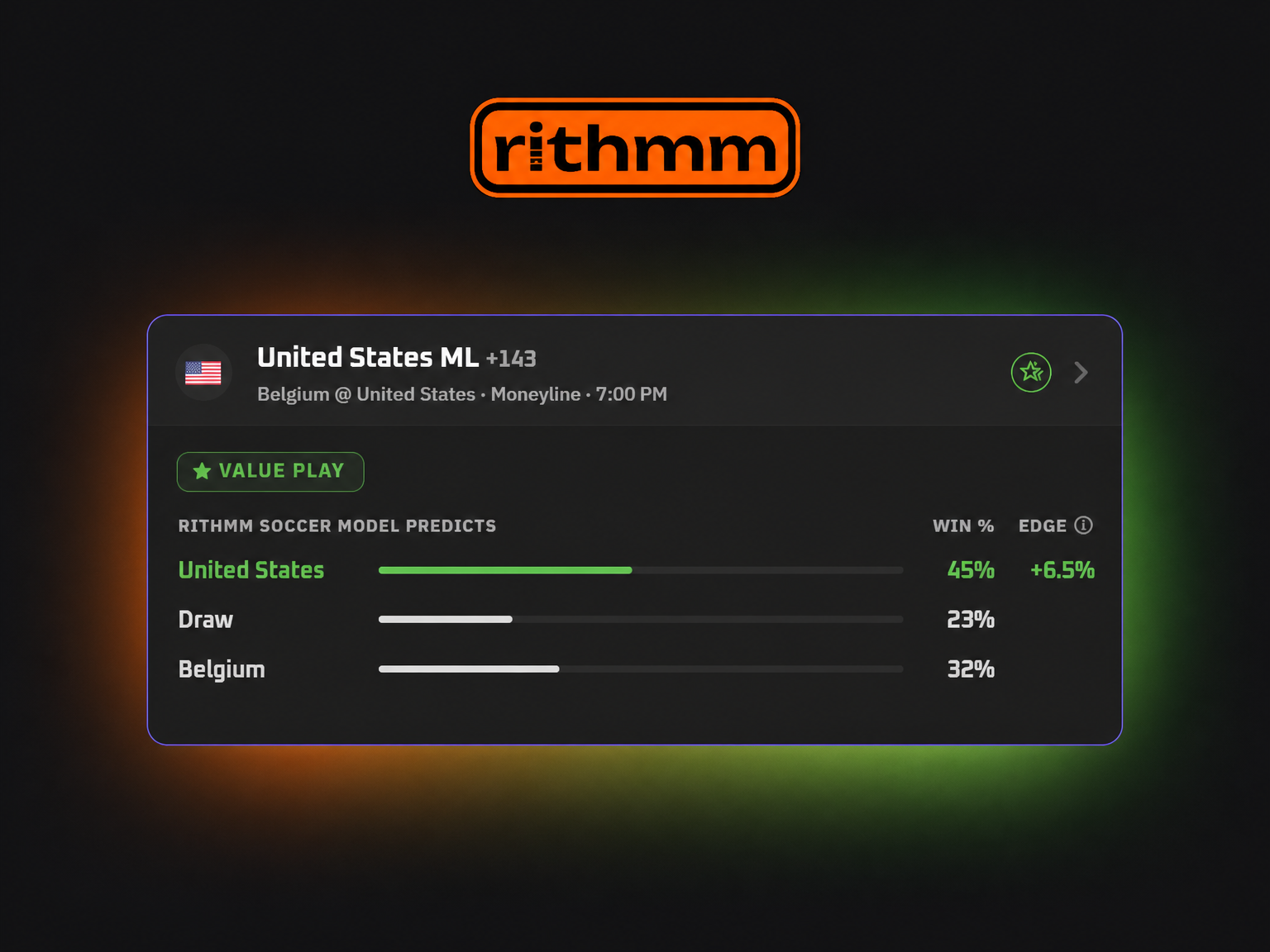
Rithmm’s models are built around that distinction. The platform’s Difference to Market (DTM) metric measures exactly how far a model’s prediction sits from the sportsbook’s line. A positive DTM signals that the models see more value than the market is offering. And when the models find a signal worth acting on, the pick gets a Recommended tag in the app. You don’t have to do the math yourself. The tag is the signal, and the DTM is the reasoning behind it.
How Rithmm Approaches the 2026 World Cup
Rithmm launched its World Cup beta ahead of the tournament for exactly this reason. With 104 matches across group stage, Round of 32, quarterfinals, semifinals, and the final, there’s no shortage of opportunities. But not every match has a strong signal.
The models look for historical patterns that match the current conditions. Tournament soccer carries its own tendencies that differ from domestic league play. Group stage dynamics, where teams manage results against qualification scenarios, behave differently than knockout matches where a single mistake ends everything. The models account for that context rather than applying a one-size-fits-all prediction to every game.
When a pattern is strong, it shows up clearly in the DTM, and the pick earns a Recommended tag. A Recommended pick on a World Cup match means the models are detecting something the line hasn’t fully priced in. That’s the kind of intelligence that separates a Rithmm pick from a chatbot bracket.
What Makes a Strong World Cup Pick
Not every match on the board is worth betting. That’s an important truth that most “AI predictions” content skips entirely. The smart approach is patience: wait for the conditions where the models are seeing a meaningful signal, rather than forcing a pick on every fixture.
In a 104-match tournament, the volume of games creates real opportunity. But volume also creates noise. The bettors who come out ahead are the ones filtering for signal rather than chasing action on every kickoff.
Rithmm’s approach is built around this. The app surfaces the picks where the models have identified a pattern worth backing, flags them with a Recommended tag, shows you the reasoning behind it, and lets you make an informed decision. You’re not guessing. You’re not copying a chatbot bracket. You’re acting on data.
How to Use Rithmm for World Cup Picks
The process is straightforward. Open the app, filter for World Cup fixtures, and look for picks carrying the Recommended tag. That tag means the models found a positive DTM, a gap between their prediction and the line the sportsbook is offering. The stronger the signal, the more confidence the models have in that specific line.
For group stage matches, pay attention to totals and team-specific lines where historical scoring patterns are most likely to show up clearly. For knockout matches, the matchup dynamics shift and the models adjust accordingly.
Rithmm’s 7-day free trial gives you access to the full model output across the entire tournament group stage, which runs through late June. That’s the phase where betting volume and market inefficiencies are highest. It’s the right time to see what the models are flagging.
The World Cup Betting Advantage Starts With the Right Question
Everyone wants to know who wins the World Cup. That question is fun, and the answer is probably Spain or France if you’re listening to the consensus.
But the question that actually matters for bettors is simpler: where is the line wrong tonight?
That’s the question Rithmm’s models are built to answer. Not just for the World Cup final, but for every group stage fixture between now and July 19th.
The tournament just started. The data is live. Look for the Recommended tag and start with what the models are seeing.