

Super Bowl Prop Strategy Using Predictive Models with Rithmm
Why the Super Bowl Is Different for Player Props
The Super Bowl is the most bet-on game of the year, and that attention changes how markets behave.
Casual money floods in, narratives dominate coverage, and player props become the most popular way people engage with the game. Receptions, rushing attempts, and yardage props often draw more action than spreads or totals.
That makes the Super Bowl exciting, but it also makes it dangerous to rely on instinct alone.
This is where predictive models matter most.
What the Data Says About NFL Player Props This Season
During the NFL regular season, Rithmm’s recommended NFL player props performed at a professional level across a large sample.
Recommended NFL Props, Regular Season
Opening lines: 1340–1082, +119.78 units
Closing lines: 1387–1170, +84.09 units
That performance matters because it wasn’t driven by one-off plays or viral picks. It came from consistently applying the same process across hundreds of games and thousands of player props.
The NFL Prop Types That Stood Out
Certain prop categories consistently outperformed during the regular season.
Receptions finished 373–306 for +29.87 units
Rushing attempts finished 187–121 for +52.12 units
Rushing yards finished 182–123 for +42.87 units
Receiving yards finished 308–248 for +23.21 units
These results highlight an important theme. Volume-based props and usage-driven stats tend to be more stable than narrative-driven outcomes.
That stability is especially important on Super Bowl weekend.
Why Predictive Models Matter More on the Super Bowl
On Super Bowl weekend, everyone has an opinion.
Players are overanalyzed, single-game narratives take over, and recent performances are often overweighted. Predictive models help cut through that noise by grounding decisions in historical distributions, usage patterns, and game context.
Instead of asking who will “step up” on the biggest stage, models ask more useful questions.
How often does this player reach this number?
What does their role suggest about volume?
How does the matchup influence opportunity, not just efficiency?
That shift in thinking is critical when markets are crowded with emotion.
How to Apply This Approach on Super Bowl Weekend
A model-driven Super Bowl process starts with player props, not parlays.
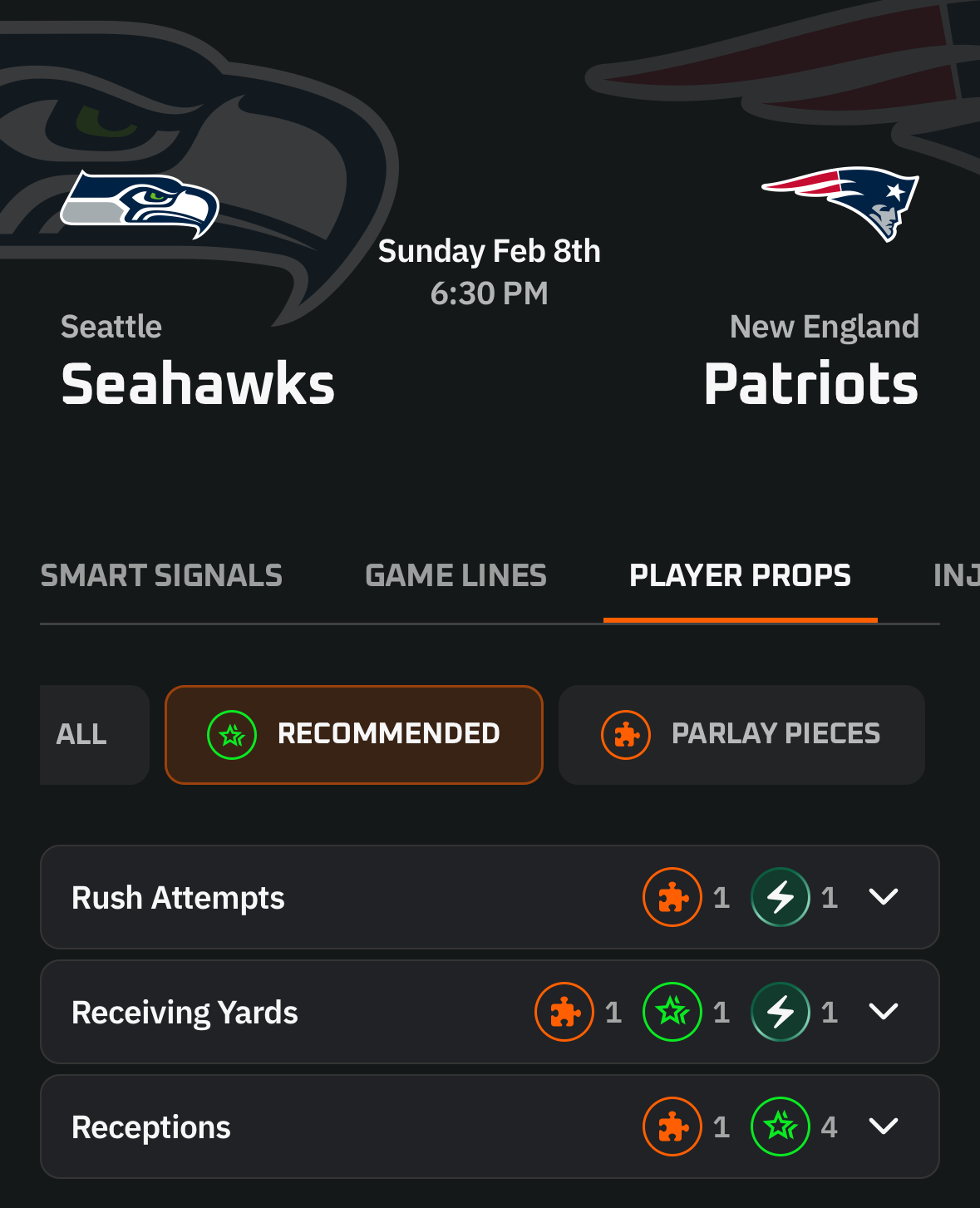
Rather than building slips around narratives, the focus stays on identifying props where projected outcomes meaningfully differ from posted lines. Receptions, rushing attempts, and yardage props often provide clearer signals than touchdown-related markets.
The goal is not to bet more because it’s the Super Bowl. The goal is to stay disciplined when the spotlight is brightest.
That same approach applies whether props are placed on sportsbooks, pick’em platforms, or contract-based markets.
Same Process, Bigger Stage
The Super Bowl doesn’t require a new strategy. It requires sticking to a good one.
The same predictive modeling process that performed across the regular season applies on the biggest game of the year. The math doesn’t change because the audience is larger.
Super Bowl weekend simply magnifies the difference between disciplined decision-making and emotional betting.
Final Thoughts
The Super Bowl is fun because it’s chaotic. It’s profitable only if you stay structured.
This season’s NFL prop performance reinforces a simple truth. Long-term results come from process, not moments.
Predictive models help keep that process intact, even when the stakes feel higher and the narratives are louder.
That’s how serious NFL prop bettors approach Super Bowl weekend, and it’s why the same framework continues to work year after year.