

WNBA Picks Today: How AI Models Find Value in Every Slate

The WNBA is one of the most underrated betting markets in American sports. The lines are thinner, fewer bettors specialize in it, and oddsmakers dedicate fewer resources to setting precise numbers on every game. That combination creates genuine value for anyone willing to look at the data instead of guessing.
The problem? Most bettors still approach WNBA picks the way they approach every other sport: gut feeling, group chat, whoever sounds most confident on a podcast. They end up guessing more than they admit, and the book keeps winning.
Here is what a smarter approach looks like.
What Makes a Good WNBA Pick?
A good WNBA pick is not the one that feels right. It is the one backed by the data the sportsbook does not want you to see clearly.
There are three core factors that separate sharp WNBA picks from noise:
1. Line Value
The question is not "who do I think wins?" It is "is the line wrong?" The WNBA market is thinner than NBA, NFL, or MLB, which means oddsmakers sometimes set numbers that do not fully reflect the real probability of an outcome. When a model's prediction diverges significantly from the sportsbook's line, that divergence is where value lives.
2. Historical Pattern Performance
WNBA player props in particular carry strong historical patterns. A player who has covered a points over in 70%+ of her last 15 games under a specific set of conditions is a pattern, not a fluke. That kind of data is exactly what separates a confident bet from a coin flip.
3. Model Consensus
When multiple independent data inputs point in the same direction, the confidence level on a pick rises. A single indicator is interesting. Three or four converging signals are meaningful.
Types of WNBA Bets Available Today
Before looking at picks, it helps to understand the full menu of what is available on any given WNBA slate.
Moneyline
The simplest bet. You pick which team wins. WNBA moneylines can carry significant juice on heavy favorites, so line shopping between sportsbooks matters.
Point Spread (ATS)
The sportsbook assigns a handicap to the favorite. Betting ATS means picking whether a team covers that number, not just whether they win. This is where model-driven predictions add the most value for game bets.
Totals (Over/Under)
The combined score of both teams. WNBA totals tend to be lower-scoring affairs than NBA, typically ranging from 155 to 175 depending on the matchup. Pace, defense, and roster depth all factor into model projections.
Player Props
Individual player performance lines: points, rebounds, assists, three-pointers, and combination props. WNBA props are where the largest inefficiencies exist. Books set these lines with less precision than their NBA counterparts, and models trained on historical player data can identify genuine mismatches consistently.
Parlays
Combining two or more picks into a single slip. Higher risk, higher reward. The key is building parlays from individually strong picks rather than stacking long shots hoping to get lucky.
How to Find Value in WNBA Player Props
WNBA player props today represent the best opportunity for an informed bettor to find consistent value. Here is why.
The market is thin. Oddsmakers spend significantly more time and data resources on NBA player props than WNBA. The result: lines that are frequently miscalibrated relative to what a well-trained model would predict.
Look for Parlay Pieces. The strongest prop bets tend to be ones with both high win probability and positive DTM (Difference to Market). These are the picks where the model's projection is meaningfully above the sportsbook's implied probability. When a bet checks both boxes, it belongs in a parlay.
Top props to watch on any given WNBA slate:
- Points props: Stars like A'ja Wilson, Caitlin Clark, and Paige Bueckers have deep enough historical samples to reveal consistent patterns.
- Assists: Playmakers in high-pace systems generate reliable assist prop value.
- Three-pointers made: Highly variable, but strong patterns emerge for known shooters in favorable matchups.
- Combo props (pts+reb+ast): Broader lines often carry less sharp attention and more inefficiency.
WNBA Picks and Parlays: What the Data Says
The temptation with WNBA picks and parlays is to stack the biggest names and hope the slate goes your way. That is the approach that burns most bettors. The smarter build looks like this:
Lead with high-probability props. Your parlay anchor should be a bet with 65%+ model win probability. This is typically a well-established player prop where the historical data is deep and the pattern is clear.
Add a game total or spread with model backing. When a team's offensive pace and defensive profile create a clear lean on a total, that adds a second high-confidence leg.
Keep it to 2-3 legs. Each additional leg multiplies the odds but also the variance. A tight 3-leg parlay built from genuinely strong picks pays well and stays grounded in data.
Avoid the trap of parlaying for the payout. The most common mistake is starting with a desired payout and working backward to build a slip. Start with the strongest individual picks and let the parlay form naturally.
Why AI Models Are Changing WNBA Betting
Three years ago, AI-driven predictions for WNBA were essentially nonexistent in consumer betting tools. The focus was always on NFL, NBA, and MLB. Now, the WNBA's explosive growth in viewership (TV ratings up over 200% in three years), new expansion teams, and a historic CBA have attracted serious data attention.
What changed: the sample sizes are deep enough to train meaningful models. A full WNBA season features 40 games per team. Player props generate thousands of data points per season across dozens of markets. That is more than enough to surface patterns that a casual bettor would never find manually.
The best AI sports betting models approach WNBA predictions the same way they approach any sport: they find where the sportsbook's implied probability diverges from the model's calculated probability. When the divergence is large and consistent, that is where value hides.
WNBA betting offers more of those divergence opportunities per slate than almost any major market. The books know it. The sharp money knows it. Most everyday bettors do not.
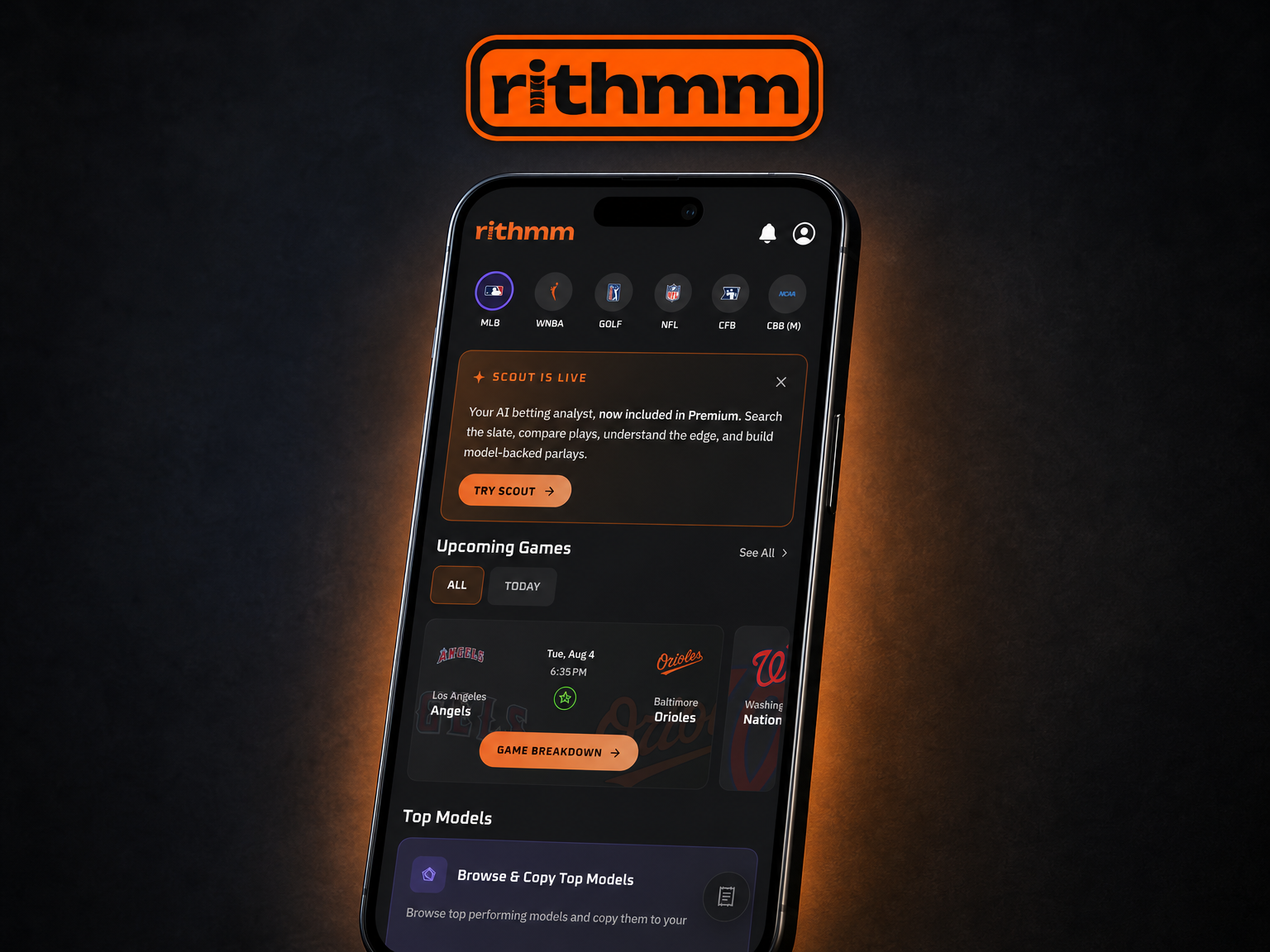
How Rithmm Builds WNBA Picks
Rithmm's models run on one core question for every bet on every slate: where is the sportsbook's line out of step with what the data actually shows?
The result is a DTM score: Difference to Market. This is the gap between what Rithmm's predictive model calculates as the true probability of an outcome and what the sportsbook's line implies. A positive DTM on a player prop means the model sees the bet as significantly more likely to hit than the book's price suggests.
On any given WNBA slate, Rithmm surfaces the picks where the model has the strongest historical pattern support and the largest positive DTM. Those are the bets that belong in your slip.
The picks are tagged clearly inside the app:
You do not need to understand the model to use it. You need to understand the pick. Rithmm shows both: the recommendation and the reason behind it.
Common Mistakes in WNBA Betting
Betting on names instead of numbers. Caitlin Clark's props carry more public action than their value often justifies because her name moves money. The model does not care about popularity; it cares about probability.
Ignoring pace and matchup. A high-scoring player in a low-pace defensive matchup is a very different bet than the same player against a weak defense. Context matters.
Not shopping lines. WNBA lines vary significantly across sportsbooks. Rithmm compares lines across DraftKings, FanDuel, BetRivers, Caesars, and BetMGM so you see where the best number lives before you place.
Treating all picks equally. Not every Rithmm recommendation carries the same confidence weight. The Parlay Piece tag and Smart Signal tag indicate the model's highest-confidence outputs. Lean on those first.
Chasing losses with bigger slips. A bad day on the WNBA slate does not mean the next day needs a 6-leg parlay to recover. The model is built for the long game.
Where to Get Today's Best WNBA Picks
Every day the WNBA slate is live, Rithmm's models surface the picks with the strongest pattern backing and the clearest DTM advantage. You do not need to research every matchup, dig through injury reports, or scroll through 15 podcasters arguing about who to fade.
Open the app. See what the model is seeing. Make a more informed decision.
That is what having a data science team in your pocket actually feels like.
Try Rithmm free for 7 days: rithmm.com
Updated daily. All WNBA picks are generated by Rithmm's predictive models and reflect current season data. Bet responsibly. Must be 21+ to wager.