

Why ChatGPT Can't Actually Predict Your Sports Bets (And What Can)
TLDR
ChatGPT is a language model. It retrieves and summarizes publicly available information. It was not trained to predict sports outcomes, does not know what today's line is, and cannot tell you whether a bet has positive expected value. A purpose-built sports prediction tool does. The distinction matters more than most bettors realize.
The Question Everyone Has Asked at Least Once
Type "who should I bet tonight NBA" into ChatGPT and you will get a response that sounds eerily confident. It will name players, cite recent trends, mention injuries, and close with something like "based on current form, the over looks favorable here." Plausible. Readable. Completely untethered from an actual predictive model.
The problem is not that ChatGPT is giving you bad information. The problem is that it is giving you the same information anyone can find on Basketball-Reference, Statmuse, or ESPN in about four minutes. It is organizing publicly available data and presenting it in a conversational format. That is useful for a lot of things. Predicting sports outcomes is not one of them.
Understanding why requires separating two things that often get conflated: data retrieval and prediction. They are not the same operation, and the gap between them is exactly where most bettors leave money.
What ChatGPT Is Actually Doing
ChatGPT and other large language models were trained to understand and generate text. Their core function is language. They process an enormous amount of written content, learn patterns in that content, and produce fluent, coherent responses to questions.
When you ask ChatGPT about tonight's slate, it is doing one of two things: either drawing on text from its training data (which has a cutoff date and does not include this week's injury report or this morning's line movement), or, if it has web search enabled, retrieving real-time text and summarizing it for you. In either case, it is producing a readable synthesis of what is already publicly known.
What it is not doing: running today's situation through a machine learning model trained on historical sports outcomes to calculate whether the current line has edge. That is a fundamentally different technical operation. Retrieval and prediction are not the same, and a language model is optimized for the former.
The Real-Time Data Problem
Even with web browsing enabled, there is a meaningful gap between what ChatGPT can access and what a purpose-built sports intelligence tool is working with. Line movement happens all day. Sharp money moves lines before most bettors notice. A player gets scratched from warmups thirty minutes before tipoff. Injury designations shift from "questionable" to "out" in the final hours.
ChatGPT can read a news article confirming a player is out. What it cannot do is tell you what that absence has historically meant for this team's performance at this line, in this specific situation, based on years of comparable games. That analysis requires proprietary historical data and a model trained specifically to surface that signal. Text retrieval cannot produce it.
This is not a knock on what ChatGPT is. It is a precise statement of what it is not. The tool was not built for this use case, and asking it to function as a predictive model is like using a search engine to calculate expected value. You can type the question in. You will not get the math.
What a Real AI Sports Prediction Tool Actually Does
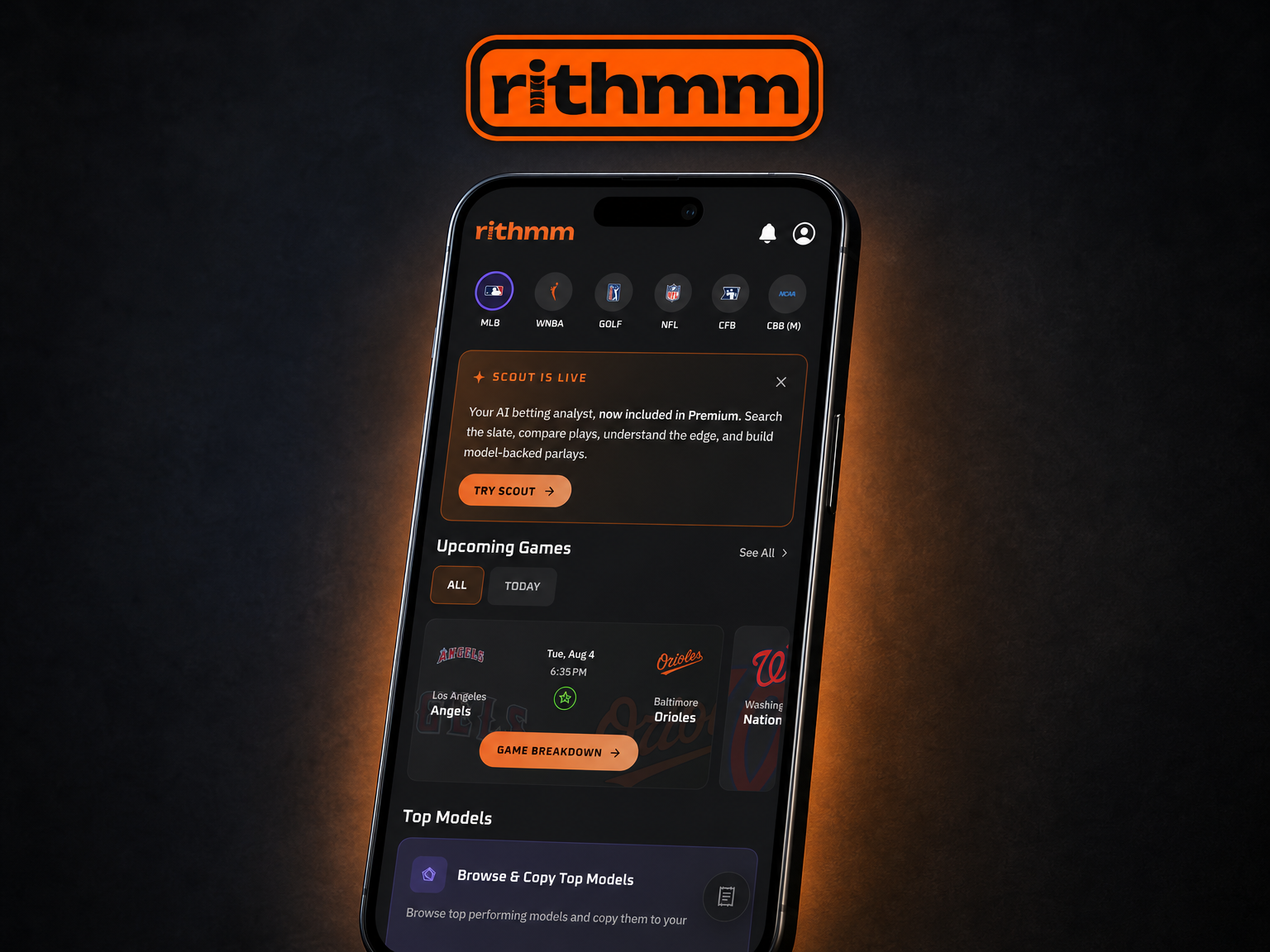
A purpose-built sports prediction platform like Rithmm is a different category of tool, not a shinier chatbot. The core of how it works is machine learning trained specifically on sports outcomes, over years of historical data, with one sole focus.
When the models flag a pick, they are surfacing a situation where today's conditions, based on years of historical sports data, show consistent value at or around this line. The models have analyzed thousands of comparable situations and surface the cases where the signal is strong enough to matter.
That is a prediction. It is not a summary of what happened last week. It is not a confidence score based on vibes. It is a calculation that says: given everything we know about how these situations have played out historically, today's number has edge here.
The transparency matters too. Rithmm shows you the reasoning. You can see why the models are flagging a bet, what the historical data looks like, and what the edge is. Rithmm does not just hand you a pick. It shows you what the data sees so you can make a confident decision.
Comparing the Two Outputs Side by Side
This is where the difference becomes concrete. Imagine you are looking at a major league baseball game tonight. A left-handed starter is going against a lineup that has been cold against southpaws, and the line opened at -115 and has since moved to -130.
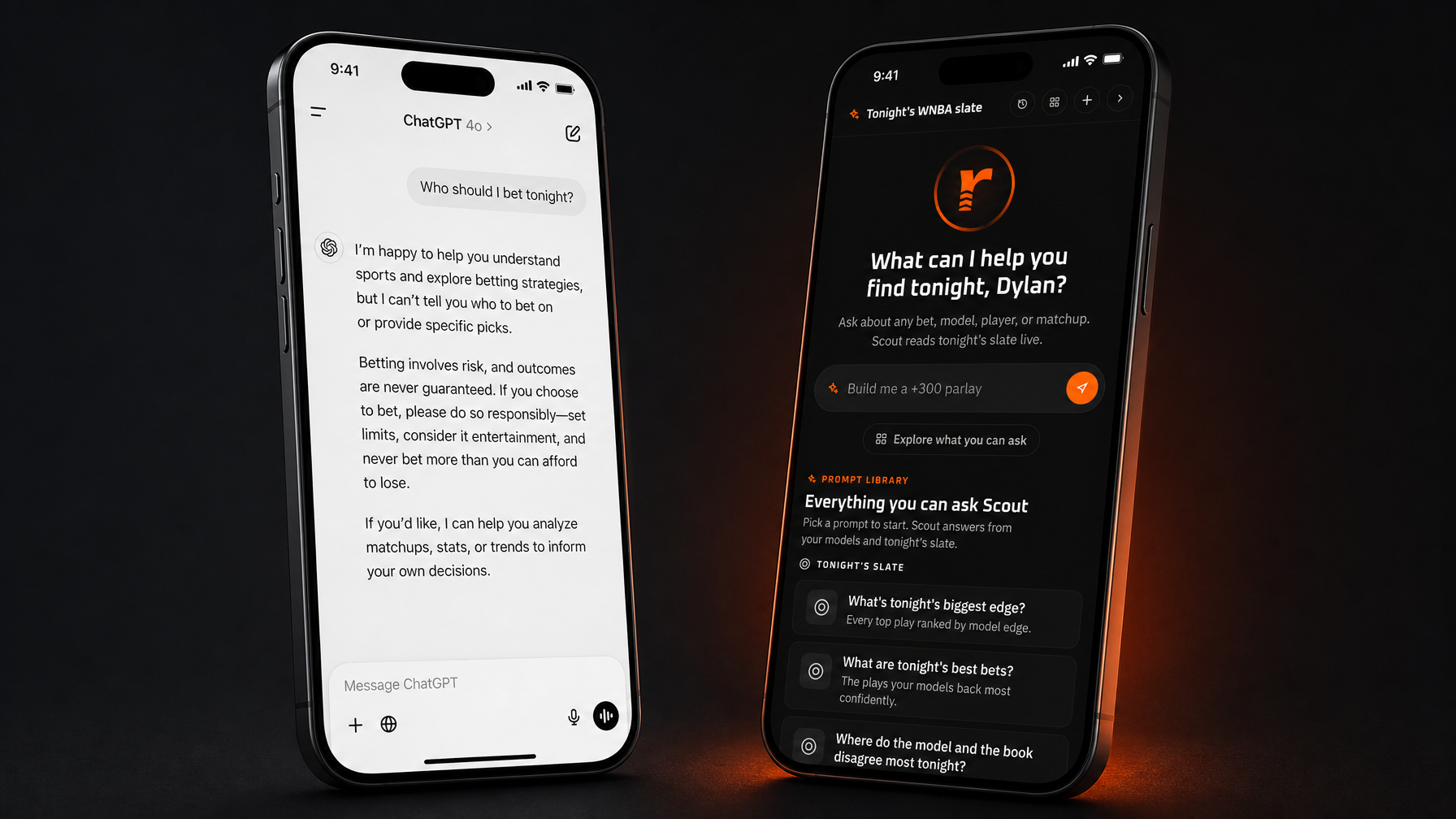
Ask ChatGPT for a pick on that game. Before you even get an answer, you will likely hit a wall. ChatGPT's content policies flag gambling-related requests and the response is typically a refusal, a heavy disclaimer about responsible gambling, or a vague hedge that stops short of giving you anything actionable. It is not built to be a picks tool, and OpenAI's guardrails reflect that. What you get, at best, is a research summary dressed up as analysis, with no win probability, no edge score, and no actual prediction attached.
Ask the Rithmm models the same question: the platform is running that situation against years of historical data on how left-handed pitchers with this profile have performed against cold lineups at this specific line range, and surfacing a win probability and edge score in plain language. That is the output of a predictive model purpose-built for this problem.
One tool tells you it cannot help. The other tells you exactly what the data shows.
Why Generalist AI Has a Structural Disadvantage
There is a reason a specialist consistently outperforms a generalist on a specific task. ChatGPT can discuss medieval history, write a Python script, and explain quantum mechanics. That breadth is impressive and genuinely useful across hundreds of use cases. It is also exactly what makes it less reliable for a problem that requires deep, single-domain expertise.
A model that is built entirely around sports betting predictions, trained exclusively on sports data, and refined over years of outcomes is operating at a depth of domain knowledge a generalist tool cannot replicate. Every update to the model, every refinement, every feedback loop is pointed at one problem: identifying value in sports betting markets. That focus compounds over time.
Kevin Meyer, a writer who documented 18 weeks of AI NFL picks side by side, noted in his writeup that even Claude's 63.8% straight-up accuracy on game outcomes did not translate to profitable betting, precisely because general AI tools do not account for line value. Beating the spread consistently requires not just predicting outcomes but identifying when the market price is wrong relative to the actual probability. That is where a purpose-built model earns its place. (Source)
Where ChatGPT Is Actually Useful
This is not a case for ignoring ChatGPT entirely. It is genuinely good for specific parts of the betting research process.
If you want a quick primer on a matchup you know nothing about, ChatGPT can get you up to speed faster than reading four separate articles. If you want to understand how a specific bet type works, what player props are available for a given sport, or what the general narrative around a team is heading into a game, it handles all of that well.
The problem is when those research capabilities get mistaken for predictive capabilities. Knowing the narrative around a game is not the same as knowing whether the current line has positive expected value. The first is context. The second requires a model.
A sharp bettor uses every tool for what it is actually good at. ChatGPT is a research accelerator. Rithmm is where the AI sports picks come from.
The Line Between Information and Edge
The sports betting market is efficient enough that information alone rarely produces consistent value. By the time something is public enough to show up in ChatGPT's response, it is public enough to already be priced into the line. Sharp bettors, sportsbook traders, and algorithmic models have already accounted for it.
What creates edge is an analytic advantage, not an information advantage. The ability to see what the historical data says about this specific type of situation, at this line, under these conditions, is not publicly available on any search result or news article. It lives inside a model trained on proprietary data with the specific goal of finding it.
That is why the bet that appears obvious from a ChatGPT research summary often has no edge, and why a pick from a purpose-built prediction tool can surface value on a matchup that does not look interesting on the surface.
What to Expect From a Real Prediction Tool
A platform like Rithmm shows you win probability, expected edge, model consensus, and the reasoning behind each pick. You are not getting a recommendation from a black box. You are getting a view into what the data is actually showing on today's slate.
For players new to data-driven betting, that transparency is the main value. You do not need to understand how machine learning works to use it effectively. You need to see that there is a real signal behind the pick, understand why it is there, and have enough context to make a confident decision.
That is the core distinction: ChatGPT gives you information. A dedicated prediction platform gives you an edge, and shows you where it comes from.
Start a 7-day free trial at Rithmm and see what the models are flagging on tonight's slate. No prior experience with predictive modeling required.
Frequently Asked Questions
Can ChatGPT pick sports bets accurately?
In most cases, ChatGPT will not give you a pick at all. Its content policies flag gambling-related requests, and the typical response is a refusal or a disclaimer about responsible gambling. When it does engage, it summarizes publicly available stats without generating an actual prediction, with no win probability, no edge score, and no expected value calculation. It was not trained to identify value in sports betting markets, and OpenAI's guardrails make it an unreliable picks tool even if you prompt it creatively.
What is the difference between ChatGPT and an AI sports betting app?
ChatGPT is a large language model optimized for text generation and information retrieval. An AI sports betting app like Rithmm is a machine learning platform trained specifically on sports outcomes, with the sole goal of surfacing bets where today's line has value based on historical data. They are different categories of tool entirely.
Does ChatGPT have real-time sports data?
With web browsing enabled, ChatGPT can access recent news and publicly available stats. What it cannot access is the kind of proprietary historical outcome data and real-time line movement analysis that purpose-built sports prediction tools are built around. Public data alone does not produce edge in an efficient market.
Is there an AI that can actually predict sports?
Predictive AI trained specifically on sports outcomes can surface situations where historical data shows consistent value. No tool can guarantee outcomes, but purpose-built platforms like Rithmm use machine learning to calculate win probability and expected edge across a full slate. That is meaningfully different from general AI summarizing public information.
What is the best AI for sports betting picks?
The best AI for betting picks is one trained specifically on sports outcomes, not a generalist language model. Rithmm's models run across MLB, NBA, WNBA, NFL, CFB, CBB, Golf, and Soccer, surfacing picks backed by proprietary historical data with full transparency on why each bet is flagged. See the AI sports picks available on today's slate.
Why does ChatGPT seem so confident about sports picks if it cannot actually predict them?
Language models are trained to produce fluent, coherent responses that match the style and tone of the question. When you ask a confident question, you get a confident-sounding answer. That confidence is a property of the language generation, not a reflection of predictive accuracy. The output sounds authoritative because that is what language models do well, not because the underlying analysis has any edge.
How does Rithmm's AI differ from a general chatbot?
Rithmm's models are machine learning systems trained exclusively on sports betting data, refined over years of outcomes, and designed specifically to identify when today's line has positive expected value. They output win probability, edge scores, and model consensus. That is a different technical operation than asking a language model to summarize a matchup, and it produces a different quality of output.
Rithmm is an AI-powered sports betting intelligence platform covering MLB, NBA, WNBA, NFL, CFB, CBB, Golf, and Soccer. Start a free 7-day trial and see what the models see.