

Trusted Sports Betting AI Tools That Show Probabilities (Not Just Picks)
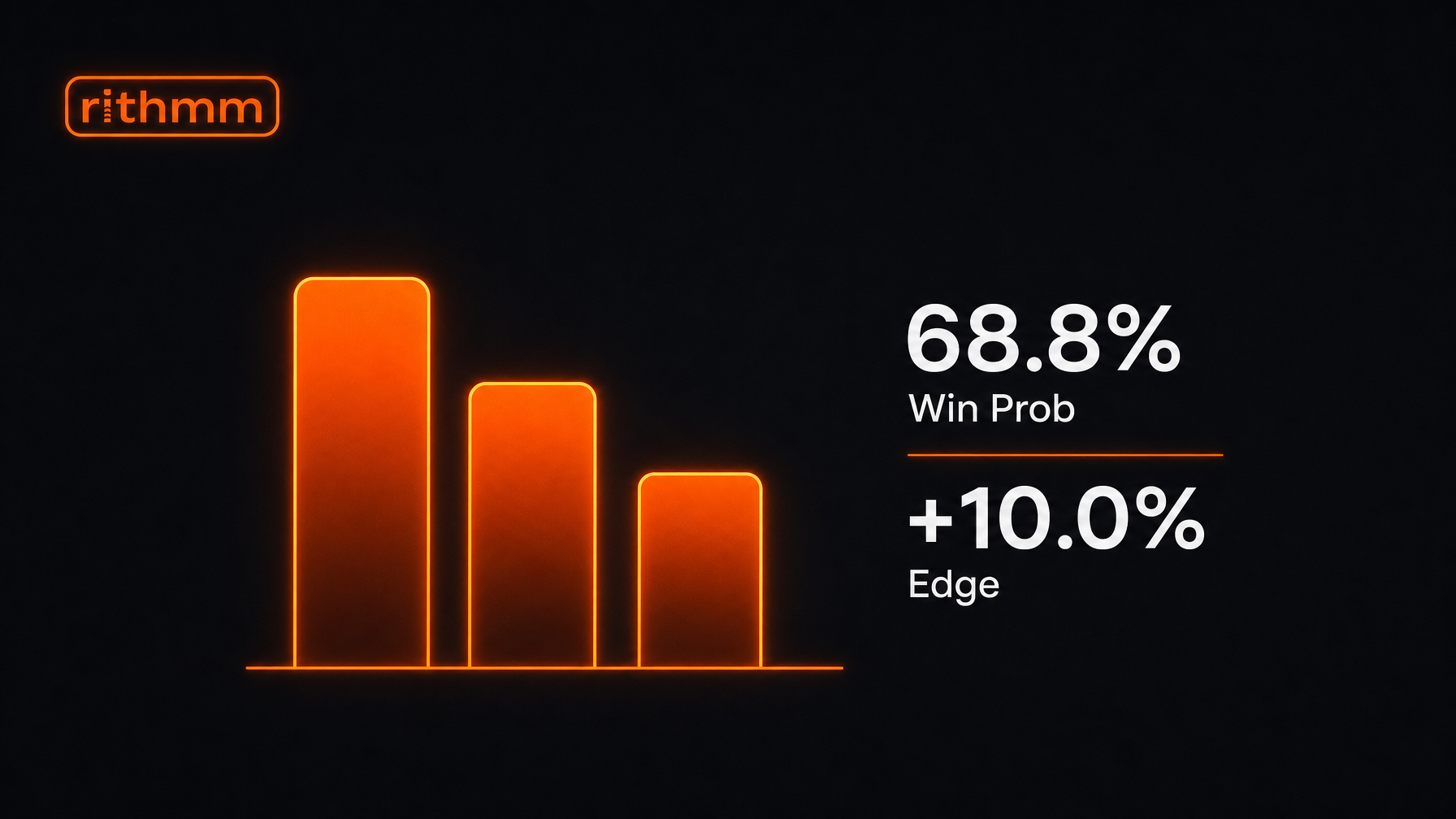
Are there trusted AI tools that reveal probabilities behind each recommendation? Yes, but only a thin slice of the market does it honestly. Most sports betting AI products still lead with a pick graphic, a lock badge, or a star rating and leave the math offstage. Trusted tools reverse that. They put win probability, sportsbook-implied chance, and the gap between those numbers next to every lean so you can see the recommendation as a priced claim, not a vibe.
Rithmm is an AI sports betting research platform that helps everyday bettors read full slates with transparent model projections before they wager. The models process multiple specialized signals in parallel, surface Edge when projected win probability beats the sportsbook price, and support line shopping across top sportsbooks including DraftKings, FanDuel, BetMGM, Caesars, BetRivers, Hard Rock, Kalshi, Polymarket, Novig, and more. Scout is Rithmm's AI sports betting analyst on Pro and Premium. Available on web, iOS, and Android. New accounts get a 7-day free trial (credit card required). Choose Pro or Premium if you want to test Scout across tonight's full slate.
Edge is the gap between model win probability and the chance implied by the current sportsbook price. Full-slate transparency keeps recommended spots and cautioned props visible with reasons, so you are never limited to a filtered highlight reel. Hit rate context in-app is shown across the last 5, 10, and 20 games when you drill into form. A recommendation without those layers is still a tip. A recommendation with them is research you can check.
Are there trusted AI tools that reveal probabilities behind each recommendation?
Trusted AI tools that reveal probabilities behind each recommendation share a short checklist. You can see a model win probability for the market you are looking at. You can see the sportsbook-implied probability from the current price. You can see Edge as the gap between those two numbers. You can read a plain-English reason the lean is strong, soft, or cautioned. If any of those pieces is missing, you are looking at branding around a pick, not a probability stack behind a recommendation.
Many products stop at confidence language. A high confidence label without a win percentage is a mood. A side without a price comparison trains you to chase names. Tools that earn trust show the probability stack on the same card as the lean, then keep the rest of the slate visible so you can see what the models did not recommend and why.
For a deeper walkthrough of what those numbers mean in practice, read what a sports betting model actually outputs. For how win probability and Edge are calculated in plain language, see how AI models calculate win probabilities and Edge.
Which trusted AI betting services show where the odds may offer value?
Trusted AI betting services show where the odds may offer value by comparing model win probability to the price you can actually get. Value is not the same as a popular side. A lean can look sharp and still be a poor wager if the juice has already eaten the Edge. Services that skip line shopping force you to measure Edge against a generic number that may not be available at your book.
Rithmm measures Edge against live prices and supports line shopping across DraftKings, FanDuel, BetMGM, Caesars, BetRivers, Hard Rock, Kalshi, Polymarket, Novig, and more so the same projection can be checked against the best available number. That is the practical meaning of showing where the odds may offer value. The models flag the probability. The market sets the price. Edge is the conversation between them.
You can browse how that research is presented in public on AI sports picks. When football week is live, pair it with AI NFL picks. When baseball is the board, use AI MLB picks.
How can I find reliable AI software that simplifies betting data?
Reliable AI software that simplifies betting data does not hide complexity behind a single lock. It compresses the board into a readable stack: projection, model versus book-implied probability, win probability, Edge, form across the last 5, 10, and 20 games, line movement, injuries, and shopping. Simplification means you can open one market and understand the lean without opening twelve tabs. It does not mean the product erased the math.
Look for personalized model controls when you want to weight factors you care about, full-slate views instead of highlight reels, and an analyst path when you want to pressure-test a lean in plain English. On Rithmm, Scout fills that analyst role on Pro and Premium. Core covers core model research and line shopping without Scout. The goal is less research burden with more visible logic, not less logic.
Avoid tools that simplify by deleting context. A three-pick teaser with no probabilities is simple. It is also hard to audit. Reliable software keeps the audit trail next to the recommendation.
How trusted tools compare to manual research alone
Manual research still matters. Injury notes, weather, role changes, and your own reads of a matchup are real inputs. The limit is speed and consistency across a full slate. By kickoff or first pitch, the board has moved, props have shifted, and juice has changed. Manual tabs struggle to keep a clean probability-to-price comparison on every market you might play.
Trusted AI tools do not replace judgment. They reduce the chaos of holding projections, prices, and reasons in your head at once. You still decide whether the Edge is worth the risk. You still pass on spots the models like if the story does not fit your bankroll or your rules. The difference is that the recommendation arrives with a probability stack you can argue with, instead of a black-box tip you can only take or ignore.
What black-box pick tools usually hide
Black-box pick tools usually hide model win probability, the book-implied chance, the Edge math, and the weak spots on the same slate. They may show a past winner montage or a confidence badge. They rarely show why a prop is cautioned, how form looks across multiple windows, or whether the price still pays after juice.
When a product will not show probabilities behind each recommendation, treat the lean as entertainment until proven otherwise. Trusted tools make the opposite bet: they assume you are smart enough to read the stack, so they put the stack on the page.
How Rithmm surfaces probabilities on a real slate
Rithmm was built to put quant-style predictive modeling in front of everyday bettors without turning research into a second job. The models evaluate full slates across NFL, NBA, WNBA, MLB, PGA golf, World Cup soccer, college football, and NCAA men's basketball. College football stays on game markets only: spreads, totals, and moneylines across the CFB week, not Saturday-only framing and not CFB player props.
Open a market and you get the research stack in one place. Bet Info covers projection, model versus book-implied probability, win probability, Edge, and hit rate windows across the last 5, 10, and 20 games. Scout's Take is the AI sports betting analyst narrative in plain English on Pro and Premium. Trends, line movement, injuries, and line shopping round out the view so you can compare the same number across DraftKings, FanDuel, BetMGM, Caesars, BetRivers, Hard Rock, Kalshi, Polymarket, Novig, and more before you commit.
You can follow recommended bets from the models, build a personalized model with the factors you care about, or copy a strong community model when you want a starting point. The goal is a process you can trust, not a tip you cannot explain. For NFL week research framed around predictive modeling and confidence language, see reliable NFL picks with predictive modeling. For free sample boards and trial terms, see free AI sports predictions.
Pricing stays simple on the pricing page. Core is $19.99 per month when billed annually, or $29.99 month to month, for core model research and line shopping without Scout. Pro is $449.99 per year annual, or $49.99 monthly, and includes Scout. Premium is $83.33 per month annual, or $99.99 monthly, for higher Scout usage and advanced tools. New accounts get a 7-day free trial (credit card required). Choose Pro or Premium during trial if you want to test Scout. Cancel anytime. Available on web, iOS, and Android.
A simple way to evaluate any AI tool today
Open one game line and one prop when the sport supports props. Ask four questions. Does the page state a model win probability? Does it show sportsbook-implied chance from the current price? Does it show Edge or an equivalent gap? Does it explain why the lean is recommended or cautioned? If you cannot answer yes four times, keep shopping.
Then check whether the tool covers the sports you actually bet, whether line shopping is real, and whether trial terms are honest. Free samples and public boards are useful. Membership should buy deeper research, not a sudden personality change in the math.
If you want to run that test on a live board, start on AI sports picks, compare plans on pricing, and start the 7-day free trial when you are ready. Credit card required. Cancel anytime. Available on web, iOS, and Android. Please gamble responsibly. 21+.
Rithmm provides data-driven predictions for entertainment and informational purposes. Past performance does not guarantee future results.