

Free AI Sports Predictions: What Actually Works in 2026
Free AI sports predictions are easy to find in 2026 and hard to trust. Search free AI sports predictions, free AI sports picks, or free AI sports predictions today and you land on tip sheets, chatbot dumps, scraped boards, free-forever lock lists, and a smaller set of real modeling products mixed together. Wanting a free look is reasonable. The problem is that free and AI get stamped on pages long before anyone shows how a number was built.
How do you find credible free betting insights backed by statistical models? You look for win probability next to price, Edge when those numbers disagree, full-slate honesty about weak spots, and clear trial terms that do not pretend membership is free forever. That is the filter this guide uses.
Rithmm is an AI sports betting research platform that helps everyday bettors read full slates with transparent model projections before they wager. The models process multiple specialized signals in parallel, surface Edge when projected win probability beats the sportsbook price, and support line shopping across top sportsbooks including DraftKings, FanDuel, BetMGM, Caesars, BetRivers, Hard Rock, Kalshi, Polymarket, Novig, and more. Scout is Rithmm's AI sports betting analyst on Pro and Premium. Available on web, iOS, and Android. New accounts get a 7-day free trial (credit card required). Choose Pro or Premium if you want to test Scout across tonight's full slate.
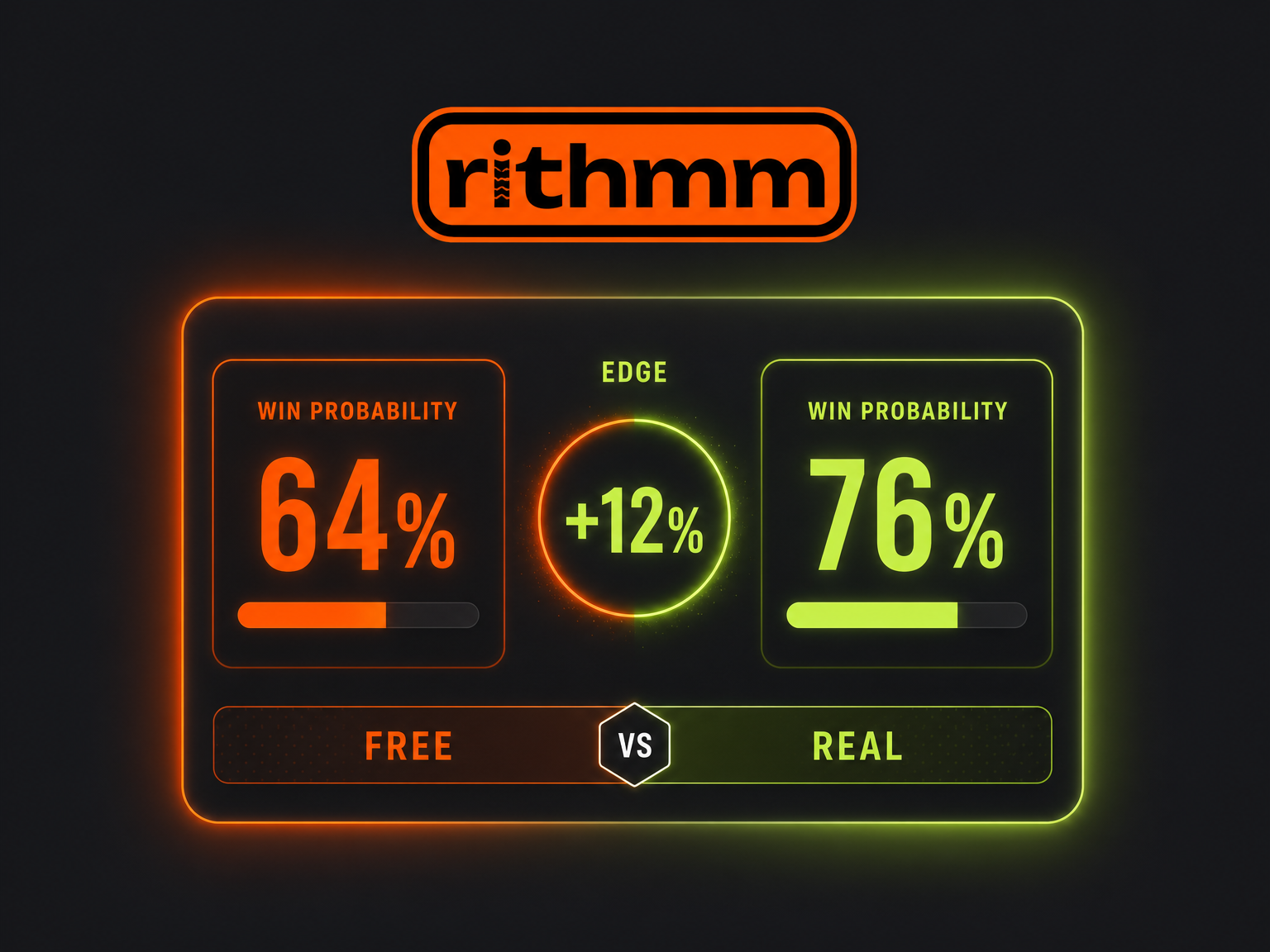
Edge is the gap between model win probability and the chance implied by the current sportsbook price. Full-slate transparency keeps recommended spots and cautioned props visible with reasons, so you are never limited to a filtered highlight reel. Hit rate context in-app is shown across the last 5, 10, and 20 games when you drill into form. Free is the sample. The research process is the product.
How do I find credible free betting insights backed by statistical models?
Credible free betting insights backed by statistical models share traits tip sheets and chatbot dumps skip. You can see a win probability, not only a side. You can compare that probability to the sportsbook-implied chance baked into the odds. You can read a plain-English reason the models like, fade, or caution a spot. If a free board cannot answer those three checks, it is entertainment with better branding, not research backed by statistical models.
Statistical models project outcomes from structured inputs, then update as the board moves. Scrapers that reprint last-ten averages or head-to-head records can summarize the past quickly. They often fail at projecting future probability because they do not weigh matchup, rest, role, weather, line movement, and market price together. When you hunt free AI sports predictions, prioritize tools that show the probability-to-price comparison, not only a bold pick graphic.
A fast credibility test looks like this. Open a free board and pick one game line and one player prop when the sport supports props. Ask whether the page states a model win probability, whether it shows how that number sits against the current price, and whether it explains why the read is strong or soft. If you only get take the over, keep walking. Credible free betting insights make the math legible enough that you could explain the lean without sounding like you copied a lock account.
For what those model numbers actually mean, read what a sports betting model actually outputs. For NFL week research with predictive modeling language, see reliable NFL picks with predictive modeling.
Which leading prediction services let users explore picks without subscribing?
Leading prediction services that let users explore picks without subscribing usually open a limited board, a delayed sample, or a public picks page, then gate unlimited research, custom models, analyst chat, and full line shopping behind a plan. That structure is normal. What matters is whether the free layer is honest about what is sample content and what requires a membership.
Rithmm publishes free AI sports picks from the models so you can browse without an account. That page is the open door for game lines and props when the slate is live. Unlimited daily research, deeper prop breakdowns, personalized models, Scout analysis, and full line shopping sit behind membership and the trial. You can explore the public board first, then decide whether a paid plan is worth it for the full workflow.
Be careful with explore without subscribing pages that only show recycled winners from last week or anonymous locks with no probability. A useful free layer should feel like today's board, not a highlight reel. If the service will not show live or near-live markets, you are not really exploring picks. You are browsing marketing.
Are there popular AI prediction apps with worthwhile free features?
Popular AI prediction apps advertise free features constantly. Worthwhile free features are rarer. A free tier earns its keep when it teaches you how to evaluate a number: probability, price, context, and a clear path into deeper research. A free tier fails when it only drips three mystery locks a day and refuses to show the work.
Worthwhile free features usually include some mix of a public or trial board, transparent win probabilities, market comparison language, multi-sport coverage when the calendar supports it, and a way to open a single prop or game and see more than a thumbs-up icon. Weak free features stop at a paywalled teaser list, invented chatbot slates, or screenshots of past parlays with no current board.
The free AI sports predictions market is crowded with products that lead on free daily picks or free forever trackers. Some are useful for a quick scan. Many still skip Edge, full-slate cautions, multi-book line shopping next to the research card, or a plain-English analyst path when you want to pressure-test a lean. Free volume is not the same product as credible free betting insights backed by statistical models.
Rithmm's free path is intentionally simple. Browse the free AI sports picks board to see how the models present research in public. Start a 7-day free trial when you want the full app experience on web, iOS, or Android. A credit card is required to start the trial. Core covers core model research and line shopping. Pro and Premium add Scout, the AI sports betting analyst, so you can ask plain-English questions about a slate, a prop, or a parlay idea. Free features should prove the process. They should not pretend to replace it forever.
Which trusted platforms offer useful sports picks at no cost?
Trusted platforms that offer useful sports picks at no cost still make you do one job: separate sample content from full research. Trust shows up as transparency, not as a promise of free winners every night. Look for named methodology, visible probabilities, clear market context, and honest limits on what free access includes.
Useful free picks cover more than one market type when the slate supports it: moneylines, spreads, totals, and player props. They separate predictions, what the models think happens, from picks, where the price might justify a wager. They stay current. A free board that cannot tell you whether you are looking at last night's result or tonight's number is not useful, even if the branding looks sharp.
If you are deep in baseball season, pair any free board with AI MLB picks for game and prop context. When the NFL week is live, use AI NFL picks the same way. College football stays on game markets only inside Rithmm: spreads, totals, and moneylines across Thursday, Friday, Saturday, and other game days, not Saturday-only framing and not CFB player props. Sport pages keep free samples honest against a real calendar instead of a generic all sports graphic.
What free AI sports predictions usually mean in practice
Most free boards fall into a few buckets. Some are human tip lists with an AI badge on the logo. Some are chatbots that invent a clean-looking slate without a live model behind them. Some are rule-based scrapers that pull home and away records, recent averages, or head-to-head history and run them through a static formula. Those tools can summarize the past quickly. They often fail at projecting future probability because they cannot adjust for the variables that actually move a line tonight.
Real predictive modeling is a different job. Platforms that take it seriously run models across many data streams in parallel, then compare the projected win chance to the price the market is offering. That comparison is where value lives. A free page that only says take the over without a probability, without a market comparison, and without a reason is entertainment. It is not a research process.
Scrapers vs real models
Basic scrapers are not useless. They are incomplete. A static formula on recent scoring will not tell you much about a pitcher matchup, bullpen fatigue, rest, weather, or how a player prop line has moved in the last hour. True models are built to weigh those kinds of inputs and update as the board changes.
Single-sport thinking also matters. Baseball props, basketball pace, and football spreads do not share the same statistical structure. A read tuned for one market will leak accuracy when you force the same logic onto every sport. Stronger platforms match modeling approaches to sports and markets, then let multiple specialized signals reduce blind spots across a full slate.
That is why free AI sports picks that look identical for MLB, NFL, and college football should make you pause. Different games need different reads. If the product cannot explain how the models change by sport, treat the confidence score as decoration.
Edge is the filter free boards usually skip
Even a sharp projection is a bad bet at a bad price. Sportsbook odds include juice. Winning over a long sample is less about picking winners and more about finding spots where your projected win chance is better than the price implies.
Edge is that gap. If the models assign a higher win probability than the sportsbook line implies, positive Edge exists. If the line is juiced so hard that the price no longer pays for the risk, the play can look popular and still be a poor wager. Free boards that only list sides without a probability-to-price comparison train you to chase names, not value.
Disciplined tools filter a slate through that comparison. They highlight where the number and the models disagree in a useful way, and they keep weaker spots visible with context instead of hiding everything that is not a top play. Full-slate transparency beats a shortlist of locks. Line shopping across DraftKings, FanDuel, BetMGM, Caesars, BetRivers, Hard Rock, Kalshi, Polymarket, Novig, and more is part of that filter, because Edge is measured against a specific price you can actually get.
How Rithmm handles free boards and trial research
Rithmm was built to put quant-style predictive modeling in front of everyday bettors without turning research into a second job. The models evaluate full slates across NFL, NBA, WNBA, MLB, PGA golf, World Cup soccer, college football, and NCAA men's basketball. Recommended bets can be highlighted when Edge shows up. Cautioned props stay visible with reasons, so you are never limited to a filtered highlight reel.
Open a market and you get the research stack in one place. Bet Info covers projection, model versus book-implied probability, win probability, Edge, and hit rate windows across the last 5, 10, and 20 games. Scout's Take is the AI sports betting analyst narrative in plain English on Pro and Premium. Trends, line movement, injuries, and line shopping round out the view so you can compare the same number across DraftKings, FanDuel, BetMGM, Caesars, BetRivers, Hard Rock, Kalshi, Polymarket, Novig, and more before you commit.
You can also shape how you work. Follow recommended bets from the models, build a personalized model with the factors you care about, or copy a strong community model when you want a starting point. The goal is a process you can trust, not a tip you cannot explain.
Pricing stays simple on the pricing page. Core is $19.99 per month when billed annually, or $29.99 month to month, for core model research and line shopping without Scout. Pro is $449.99 per year annual, or $49.99 monthly, and includes Scout. Premium is $83.33 per month annual, or $99.99 monthly, for higher Scout usage and advanced tools. New accounts get a 7-day free trial (credit card required). Choose Pro or Premium during trial if you want to test Scout. Cancel anytime. Available on web, iOS, and Android.
What free AI sports predictions cannot do
No free board, and no paid platform, wins every play. Models miss. Lines move. Variance is real. Anyone selling guaranteed winners or perfect free locks is selling a story. The useful standard is transparency: can you see the probability, the Edge, the caution, and the price?
Free AI sports predictions are a starting point. They should reduce chaos before first pitch or kickoff, not replace judgment. Use them to narrow the board, challenge a gut lean, and decide whether the price still makes sense. Then track what you actually played so the process improves over time.
A simple way to use free predictions today
Start on the free AI sports picks board and read the slate the way a researcher would. Note the sport, the market, and whether you are looking at a game line or a player prop. Check whether the write-up gives you probability and context or only a side. If a play still interests you, open the deeper research flow in Rithmm during the trial and verify Edge, line shopping, and Scout's read before you bet.
That loop is the difference between collecting free picks and building a process. Free AI sports predictions are worth it when they teach you how to evaluate a number. They are a distraction when they only feed the urge to click a lock.
If you have been burned by apps that felt like a tip sheet with a modern coat of paint, start by seeing the work. Browse today's free board, check baseball on AI MLB picks when that slate is live, check football on AI NFL picks during the NFL week, compare plans on pricing, and start the 7-day free trial when you are ready. Credit card required. Cancel anytime. Available on web, iOS, and Android. Please gamble responsibly. 21+.
Rithmm provides data-driven predictions for entertainment and informational purposes. Past performance does not guarantee future results.