

How AI Models Calculate Win Probabilities and Edge in Sports Betting
Introduction
If you have ever wondered where an AI sports betting pick actually comes from, the answer is not a secret algorithm or a self-proclaimed expert's gut feeling. Modern sports analytics platforms rely on predictive modeling to convert massive datasets into clean win probabilities.
When you know how a predictive model calculates probabilities and compares them to sportsbook odds, you stop guessing and start evaluating lines like a quantitative researcher. Here is exactly how predictive models estimate game outcomes, calculate your Edge, and help you make more disciplined betting decisions.
What Is Win Probability in Sports Betting?
Win probability is an AI model's estimated percentage likelihood that a specific outcome will occur.
Unlike a sportsbook's implied probability, which is derived directly from moneyline or prop odds and includes the book's profit margin (the vigorish or vig), an independent AI model calculates win probability using pure historical data, situational variables, and matchup statistics.
For example, if a sportsbook sets a player prop for MLB total bases at -110, the book's implied probability for the Over is 52.38%. If a predictive model projects the player to go Over 1.5 total bases in 60.0% of simulated matchups, the model's win probability is 60.0%.
Implied Probability vs. Model Win Probability
To find value in sports betting, you must understand the difference between implied probability and true model win probability.
Implied probability is derived directly from sportsbook odds, includes the bookmaker's vigorish, and represents the breakeven rate needed to cover the line over time.
Model win probability is calculated by predictive algorithms, excludes bookmaker fees, and represents the pure statistical likelihood of the outcome occurring.
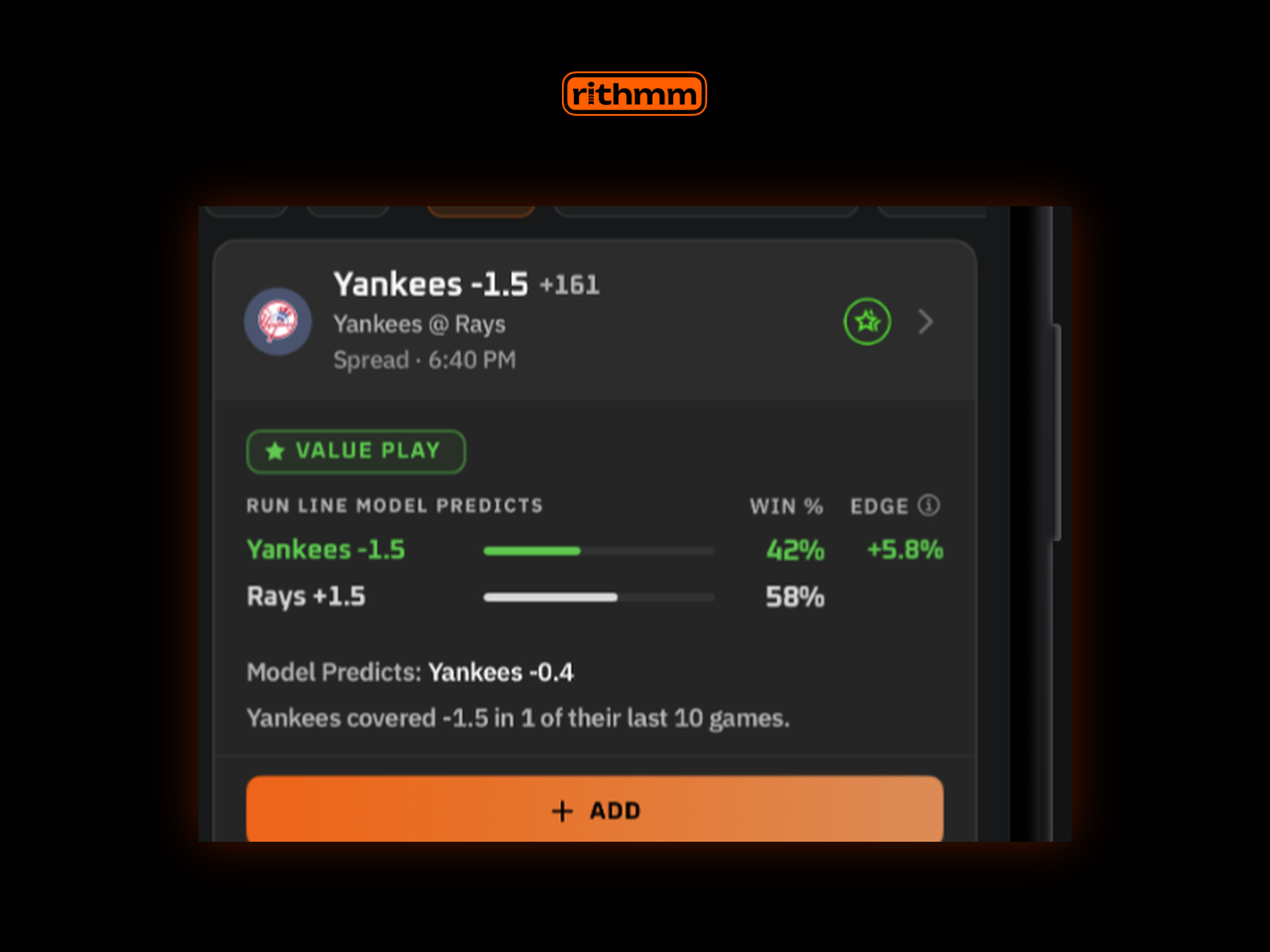
The Edge represents the model win probability minus the sportsbook's implied probability. When a model's calculated win probability is higher than the sportsbook's implied probability, an Edge exists.
How AI Models Calculate Win Probabilities Step-by-Step
Building an accurate sports prediction model requires processing thousands of data points across multiple performance dimensions. Quantitative sports models follow a structured pipeline to calculate win probabilities.
First, the system handles data ingestion and variable processing. Before a game begins, the predictive system ingests raw statistical inputs. For player props, this includes recent game logs, home and away splits, opponent matchup data, pace of play, weather conditions, and resting days.
Second, factor weighting is applied. Raw stats alone do not tell the full story. A player's performance against a top-tier defensive unit carries more weight than performance against a struggling defense. Predictive models apply factor weights to distinguish noise from actionable signals.
Third, simulation and projection take place. Using weighted factors, the system runs statistical projections across the slate. Rather than predicting a single fixed outcome, the model projects expected player stats, such as 1.4 hits or 6.2 strikeouts, and calculates the probability distribution across all possible outcomes.
Fourth, the Edge is calculated against sportsbook lines. Finally, the system compares its calculated win probability against live odds scraped from major sportsbooks including DraftKings, FanDuel, BetMGM, Caesars, and others. The difference between the model's win probability and the book's implied probability is the Edge. If a model projects an outcome at 58.5% win probability and the sportsbook's implied probability is 55.4%, the model flags a +3.1% Edge.
Why Model Transparency Matters in Sports Betting
Many sports betting services hide their calculations behind a black box, offering only a single pick or star rating without showing the underlying statistics. Transparent predictive platforms take the opposite approach by revealing the full mathematical breakdown behind every recommendation.
Full slate transparency allows sports bettors to evaluate win probability, market Edge, historical hit rates over recent 5, 10, and 20-game samples, and cautioned versus recommended signals. Clear indicators show which props offer strong value and which carry higher risk based on model consensus. By revealing the underlying data, transparent platforms empower bettors to make informed decisions rather than following unverified advice.
How to Use Predictive Models to Research Bets Faster
Using predictive analytics is not about automating every wager blindly. It is about streamlining your daily research workflow so you can spot value across dozens of games in minutes.
Start by scanning for positive Edge across the daily slate for props and lines where the models identify value against consensus sportsbook lines.
Next, review supporting trends, including recent hit rates, matchup splits, and model projections to confirm the context behind the numbers.
Then, compare lines across sportsbooks using real-time line shopping to place your bet at the sportsbook offering the best line and lowest vigorish.
Finally, leverage AI analysis by asking an AI betting copilot to summarize key matchup drivers, injury updates, and risk factors before placing your wager.
Frequently Asked Questions
Edge is the percentage difference between an AI model's win probability and a sportsbook's implied probability. A positive Edge indicates that the model projects an outcome to occur more frequently than the odds suggest.
No predictive model can guarantee individual outcomes in sports. AI models identify statistical value over large sample sizes by uncovering discrepancies between true probabilities and sportsbook market prices.
To calculate sportsbook implied probability for negative odds, divide the odds without the minus sign by the odds plus 100. For example, for -120 odds, 120 divided by 220 equals 54.55%.
Start Researching with Data-Driven Models Today
Understanding win probability and Edge shifts your sports betting approach from guesswork to data-backed research. Explore live model projections, line shopping, and player prop analysis across tonight's full slate with Rithmm. Choose a Pro or Premium plan to test Scout across tonight's full slate with a 7-day free trial.