

Beyond the Green Bars: Why Historical Betting Trends Are Failing in 2026
In modern sports betting research, “green bars” have become a psychological safety blanket.
You know the routine. You open a popular betting research app like Outlier or HOF Bets, scan a player prop, and see they’ve hit the over in four of their last five games. The row of green bars lights up. The bet feels safe.
In 2026, that feeling is often the reason bettors are losing.
As sportsbooks continue to sharpen their pricing models, relying on what already happened is no longer enough to beat the closing line. To win consistently, bettors must evolve from historians to modelers.
The Hindsight Trap: Why “4 Out of 5” Is Misleading
Historical trend tools are excellent at explaining the past. They tell you what happened yesterday, last week, or last month. But sports aren’t played in a vacuum, and markets don’t price props in isolation.
If a player hit their points over four straight games, but tonight faces a defensive scheme designed to eliminate their primary shot profile, those green bars quickly become statistical noise.
Pure trend tools fail to account for critical forward-looking factors like opponent-weighted efficiency, pace adjustments, and regression to the mean. Many so-called trends are simply statistical outliers waiting to normalize.
Why Sportsbooks Don’t Price Based on Green Bars
Sportsbooks don’t hang lines because a player hit a prop four times in a row.
They price lines based on possession-level projections, opponent-specific adjustments, usage volatility, efficiency by zone, and market behavior. That is why chasing streaks almost always means betting into inflated numbers.
Introducing Foresight: The Rithmm Difference
Rithmm was built to solve the logic gap left by trend-heavy betting tools.
Instead of stopping at what happened, Rithmm uses AI-backed predictive models to estimate what is most likely to happen tonight, given the actual matchup context.
This isn’t trend replacement. It’s trend verification.
The Power of Distance to Market (DTM)
While casual bettors chase streaks, sharp bettors look for edge.
Distance to Market, or DTM, is the mathematical gap between a sportsbook’s line and a custom AI projection.
A trend-only approach might say a player has gone over 22 points in four straight games, so 21.5 must be value. A DTM-driven approach asks why the sportsbook set the line at 21.5 and what happens after adjusting for pace, opponent efficiency, and role-based usage.
If the model projects 18.4 points, the green bars stop mattering. The math points to the under.
Don’t Just Use a Model - Build Yours
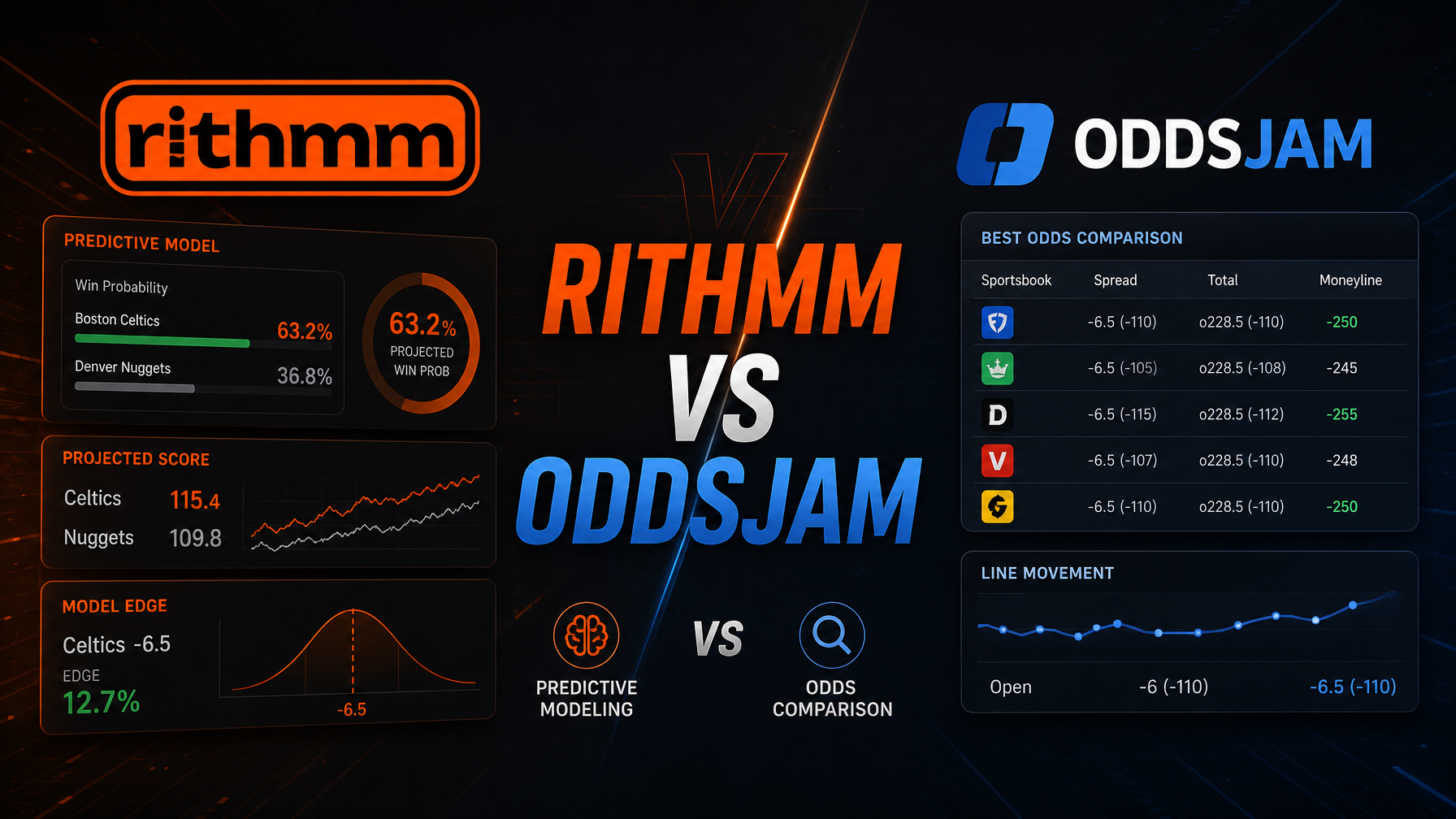
The biggest difference between Rithmm and competitors like LineMate or Outlier is agency.
Instead of being fed static trends, Rithmm gives bettors a no-code environment to build their own predictive models. Users can weight recent form, defensive metrics, pace, efficiency, or usage, then run thousands of simulations to generate outcome probabilities.
You are no longer following a streak. You are executing a strategy.
How to Pivot Your Betting Strategy in 2026
If you want to move from casual betting to mathematical decision-making, it is time to look beyond the colors on the screen.
Use hit rates as a starting signal, not a conclusion. Verify trends with predictive models. Only place bets when there is a meaningful Distance to Market versus the sportsbook.
Sportsbooks already use elite models. In 2026, bettors who want to win need one too.