

Talk to a Model: How Rithmm's Scout Turns Predictive Data Into a Conversation
Rithmm is an AI sports betting research platform that helps everyday bettors read full slates with transparent model projections before they wager. The models process multiple specialized signals in parallel, surface Edge when projected win probability beats the sportsbook price, and support line shopping across top sportsbooks including DraftKings, FanDuel, BetMGM, Caesars, BetRivers, Hard Rock, Kalshi, Polymarket, Novig, and more. Scout is Rithmm's AI sports betting analyst on Pro and Premium. Available on web, iOS, and Android. New accounts get a 7-day free trial (credit card required). Choose Pro or Premium if you want to test Scout across tonight's full slate.
Edge is the gap between model win probability and the chance implied by the current sportsbook price. Full-slate transparency keeps recommended spots and cautioned props visible with reasons, so you are never limited to a filtered highlight reel. Hit rate context in-app is shown across the last 5, 10, and 20 games when you drill into form. Before you bet. Ask Scout.
Most people who use AI in their sports betting research end up in the same place. They open ChatGPT or Perplexity, type a question about tonight's slate, and get an answer that sounds confident but has no idea what the current line is, no access to a real predictive model, and no way to check whether the answer is grounded in anything besides the language model's training data.
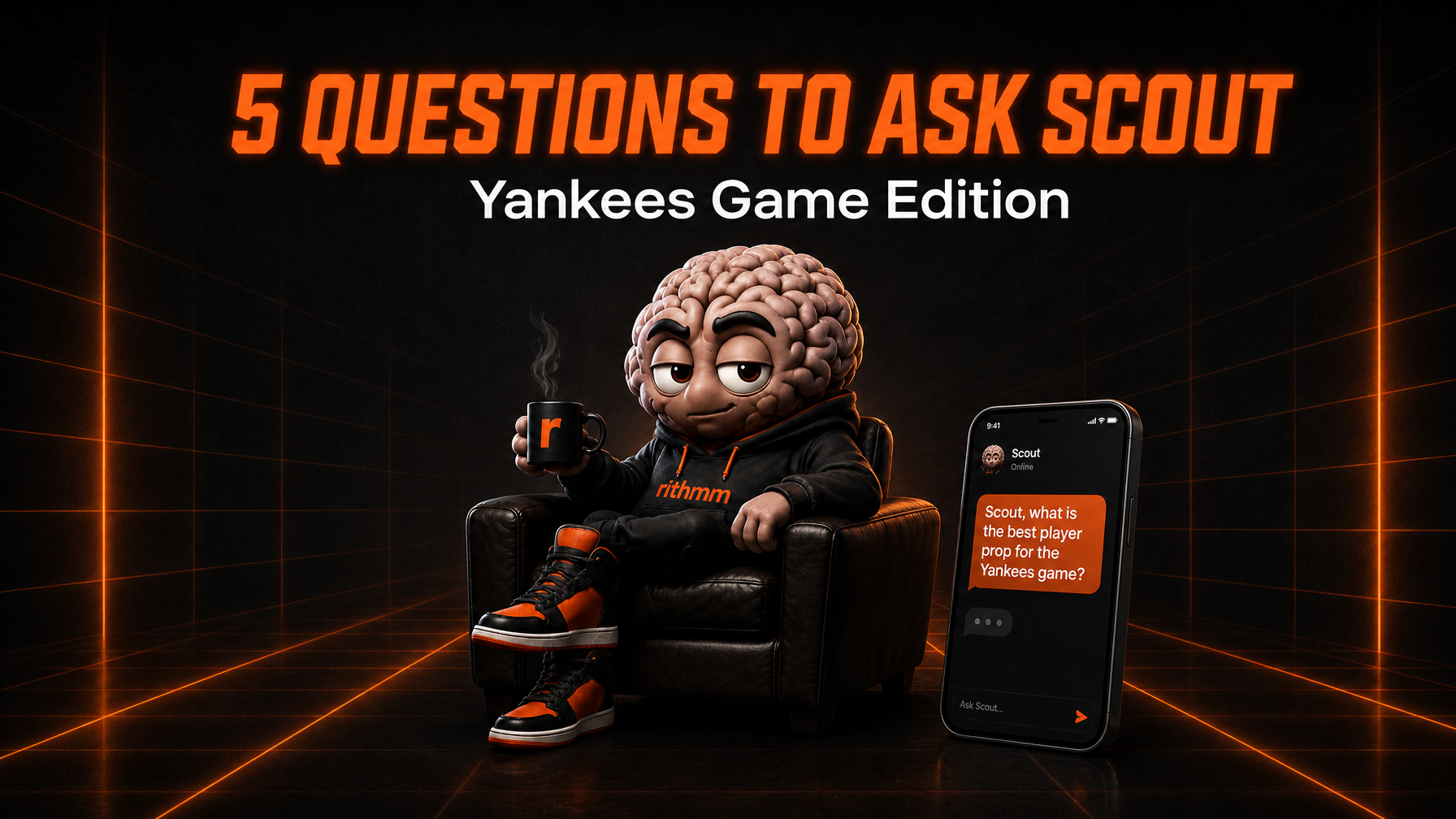
That is the wrong tool for the job. General AI is built to talk about anything. It is not built to talk about tonight's Yankees game.
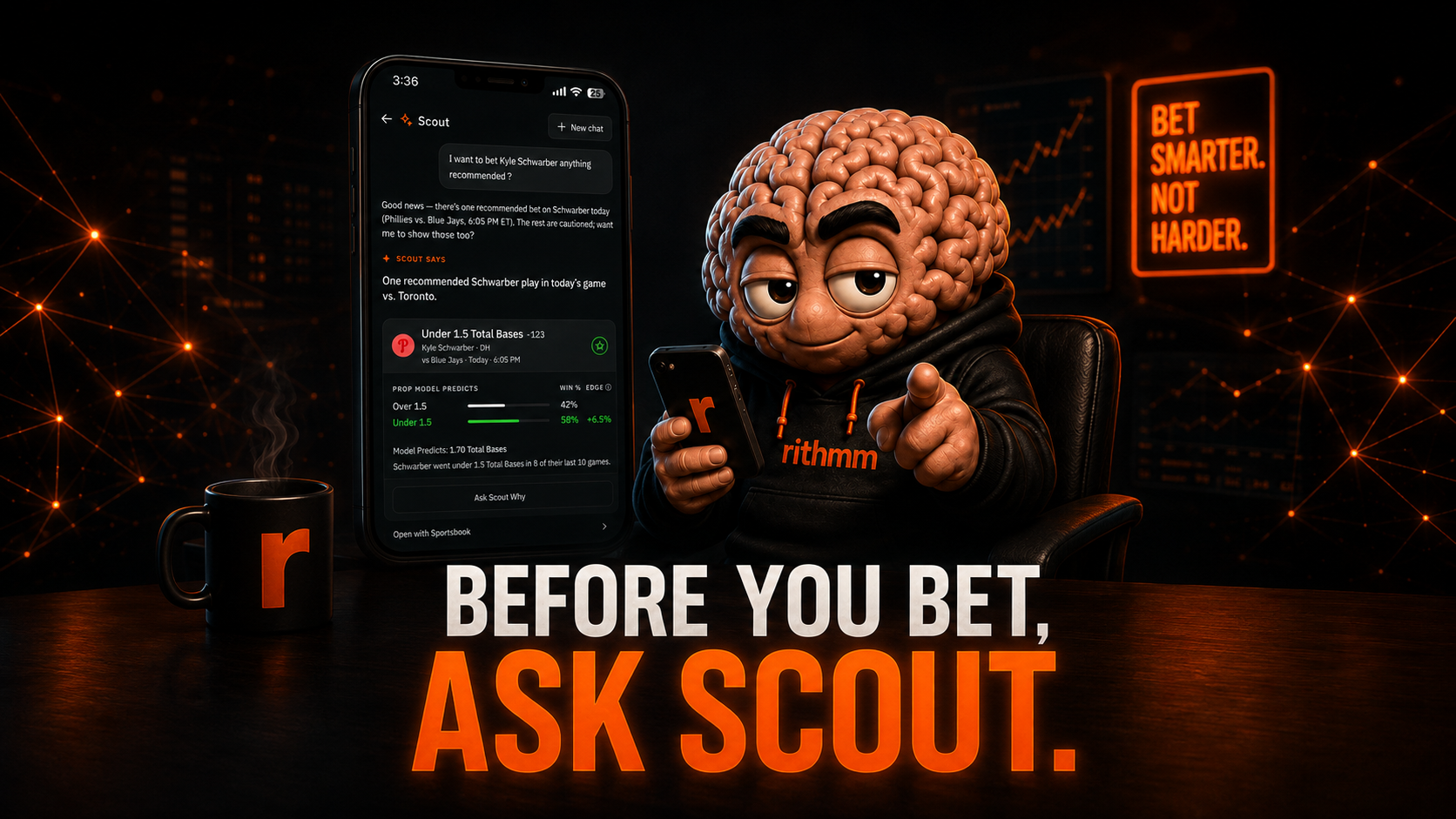
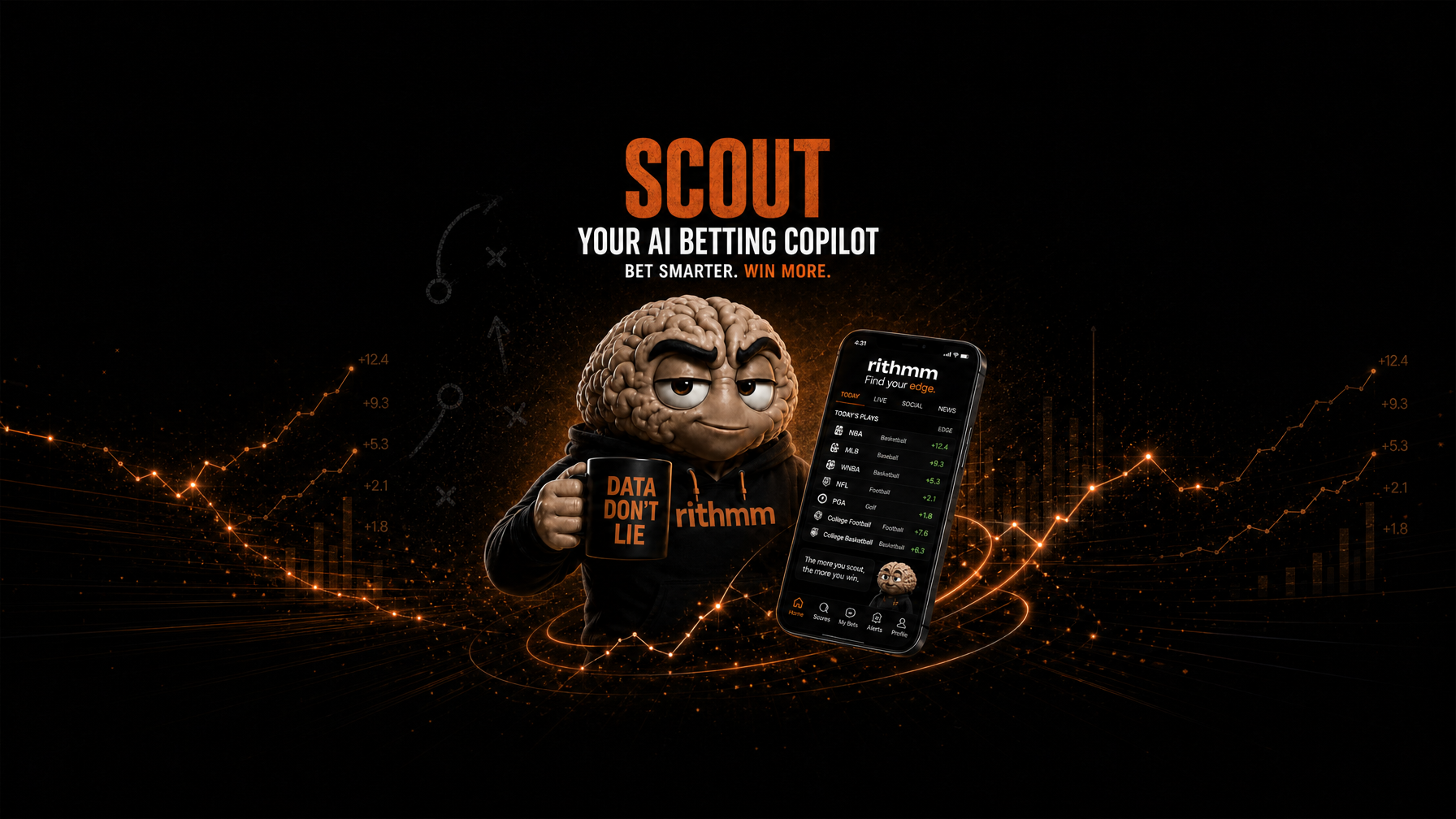
Scout is different. Scout is the AI sports betting analyst inside Rithmm, and its job is to let you talk to the models. Not to a chatbot's general knowledge of baseball. Not to a wrapper that scrapes yesterday's stats. To Rithmm's actual predictive models, the ones producing live projections, Edge signals, and hit rate context on tonight's slate.
This is a look at what talking to the models actually means, how Scout works, and the kinds of questions bettors ask when they have a natural language interface to real predictive data. For the product definition of AI sports betting research, start with AI sports betting: what it actually does. Live boards sit on AI sports picks.
The difference between talking to an LLM and talking to predictive models
General large language models are extraordinary at conversation. They are limited at prediction. When you ask ChatGPT "who should I bet on tonight," the answer is a smart-sounding guess assembled from training data that may be months old, based on no live line, no current form, and no predictive model of the sport.
That is not the same as talking to Rithmm's models.
Predictive models estimate the probability of an outcome based on structured inputs: opponent-adjusted efficiency, situational context, matchup data, recent form, line movement. When they produce a number, that number comes from math applied to current data. It is a projection, not an opinion.
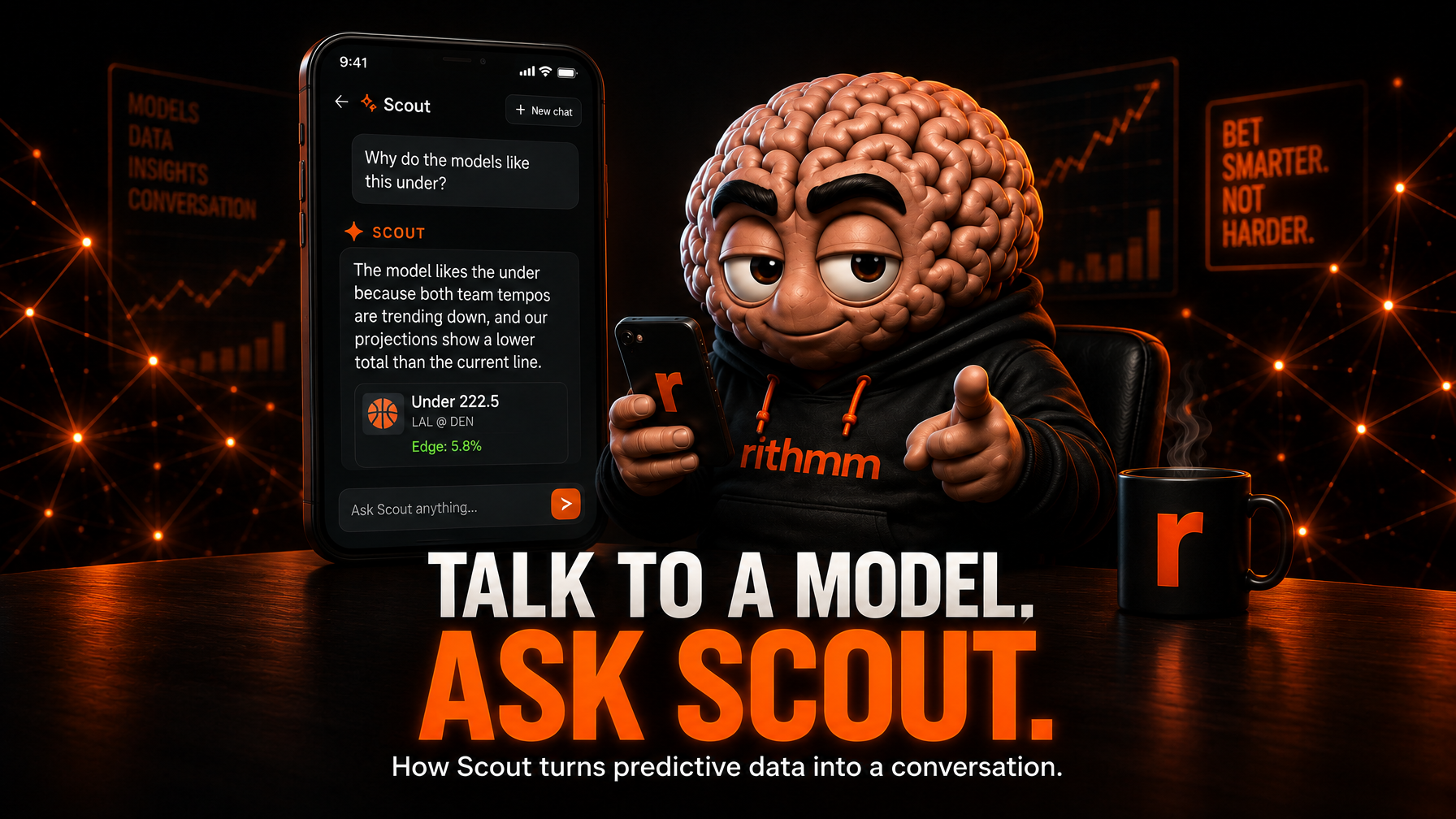
Scout is a natural language interface to that projection layer. It does use LLM technology to understand your questions and respond in plain English. That part is honest and worth naming. What separates Scout from a general AI chatbot is where the answers come from. Scout's responses are grounded in Rithmm's actual model outputs and data, not in the LLM's general knowledge of sports. The LLM handles the conversation. The models provide the truth.
That distinction is the entire point. When you ask Scout why the models like the under on a Skenes strikeout prop, you get an answer built from Rithmm's opponent-adjusted signals for that matchup. When you ask ChatGPT the same question, you get a plausible-sounding paragraph that has no idea Skenes is even pitching tonight. For how those numbers are built, read how AI sports prediction models work and how AI models calculate win probabilities and Edge.
What talking to the data actually looks like
The best way to understand Scout is to see the range of questions it can handle. These are the kinds of things bettors ask when they realize they can have a real conversation with their research tool instead of scrolling through tabs.
Questions about tonight's specific matchups sound like this. Why do the models like the under on Aaron Judge's total bases tonight? What is the projected pace for a high-profile NBA board when that slate is live in-app? What is Rithmm projecting for the total in a primetime NFL game after a wind forecast update?
Questions about specific players and props sound like this. What is a star guard's hit rate on assists over her last 10 games against pressure defenses? Which pitcher on tonight's slate has the biggest Edge on strikeouts? Why are the models cautioning on a quarterback rushing yards prop this week? When NBA props are live on the board, which big-man markets do the models currently see the most value on?
Structured research workflows for a specific game are where Scout saves the most clock. One real Rithmm user runs Scout through a five-step MLB game analysis every night: compare each team's recent batting, pitching, and fielding; compare probable starting pitching, bullpen, and batting orders; compare injury impact for both teams; pull game conditions and park factors; then ask, hypothetically, based on the current information, who should win and by how much. That entire workflow, which used to require five browser tabs and 30 minutes of manual research, becomes a conversation. Scout pulls Rithmm's model data on each question and delivers a synthesized read in plain English. MLB boards start at AI MLB picks.
Questions about model reasoning and Edge sound like this. What is Edge and why should I care about a 5% Edge versus a 12% Edge? Why did the projection on this game move overnight? Which recommended plays on tonight's slate have the highest Edge? Show me every prop where the models project more than a 60% win probability.
Questions about parlay construction sound like this. Build me a three-leg parlay with positive Edge on every leg when the sport board supports it. Give me a two-leg MLB same-game parlay with correlated Edge. Which of these four props do the models like best if I have to pick three?
Questions about slate-level strategy sound like this. Which sport has the most positive-Edge plays tonight? What are the softest lines on the board right now? Where should I focus my research if I only have 15 minutes before first pitch?
Every one of those questions gets an answer built from Rithmm's actual model outputs. Not from the LLM's general opinions about sports. Not from cached articles. From live projections, live Edge signals, live hit rate data across the last 5, 10, and 20 games, and live sportsbook prices across DraftKings, FanDuel, BetMGM, Caesars, BetRivers, Hard Rock, Kalshi, Polymarket, Novig, and more. Football prep in season lives on AI NFL picks. When NBA research is live in-app, use AI NBA picks.
Why talk to the models beats get a pick
Traditional prediction services hand you a pick and ask you to trust it. That works until you want to know why. Or until the pick loses and you have no framework for evaluating whether the loss was a bad model call or bad variance. Or until you have a question the picks list did not anticipate.
A natural language interface to the models changes that dynamic. Instead of consuming picks, you interrogate them. Instead of accepting a projection, you ask the models to defend it. Instead of guessing what the data might say about a scenario, you ask.
That workflow is faster than manual research and more honest than a picks feed. It also builds real intuition over time. Bettors who talk to the models week after week start to understand which kinds of signals the models weigh heavily, which matchups they consistently read well, and which situations they flag with caution. That understanding compounds. It is the difference between following picks and actually learning to bet.
What Scout is not
Scout does not replace the models. It translates them. If Rithmm's models do not have a projection on a specific matchup or prop, Scout cannot invent one. What Scout does is make Rithmm's projections conversational, so bettors who want to interrogate the data can do it in plain English instead of hunting through tabs.
Scout also does not exist to build hype. It will tell you when the models like a play and it will tell you when the models are cautioning against one. If you come to Scout with a lean you already have, Scout will either back it up with the models' reasoning or flag why the data disagrees. Either answer is useful. Confirming a bet with real model logic is not confirmation bias, it is doing your homework. Getting a cautioned read on a bet you were about to place is what a real research tool is supposed to do.
How to start talking to the models
Scout is included on Rithmm's Pro and Premium plans. New accounts get a 7-day free trial (credit card required), so you can test Scout across live slates before committing to a subscription. Choose Pro or Premium at signup to activate Scout access from day one. Core covers models and line shopping without Scout.
Rithmm has three tiers. Core is $19.99 per month on annual billing or $29.99 a month month to month for models and line shopping without Scout. Pro is $449.99 per year (about $37.50 per month equivalent) or $49.99 month to month with Scout included. Premium is $83.33 per month on annual billing or $99.99 month to month for higher Scout usage and advanced tools. Full plan detail lives on pricing.
Scout works across every sport Rithmm covers: NFL, NBA, WNBA, MLB, PGA golf, World Cup soccer, college football, and NCAA men's basketball. Available on web, iOS, and Android.
Open the app, choose a Pro or Premium trial, and start asking questions. The models are already reading tonight's slate. Scout will translate what they see. Before you bet. Ask Scout.
Rithmm provides data-driven predictions for entertainment and informational purposes. Past performance does not guarantee future results. Must be of legal betting age in your jurisdiction. Bet responsibly. If you or someone you know has a gambling problem, call 1-800-GAMBLER.