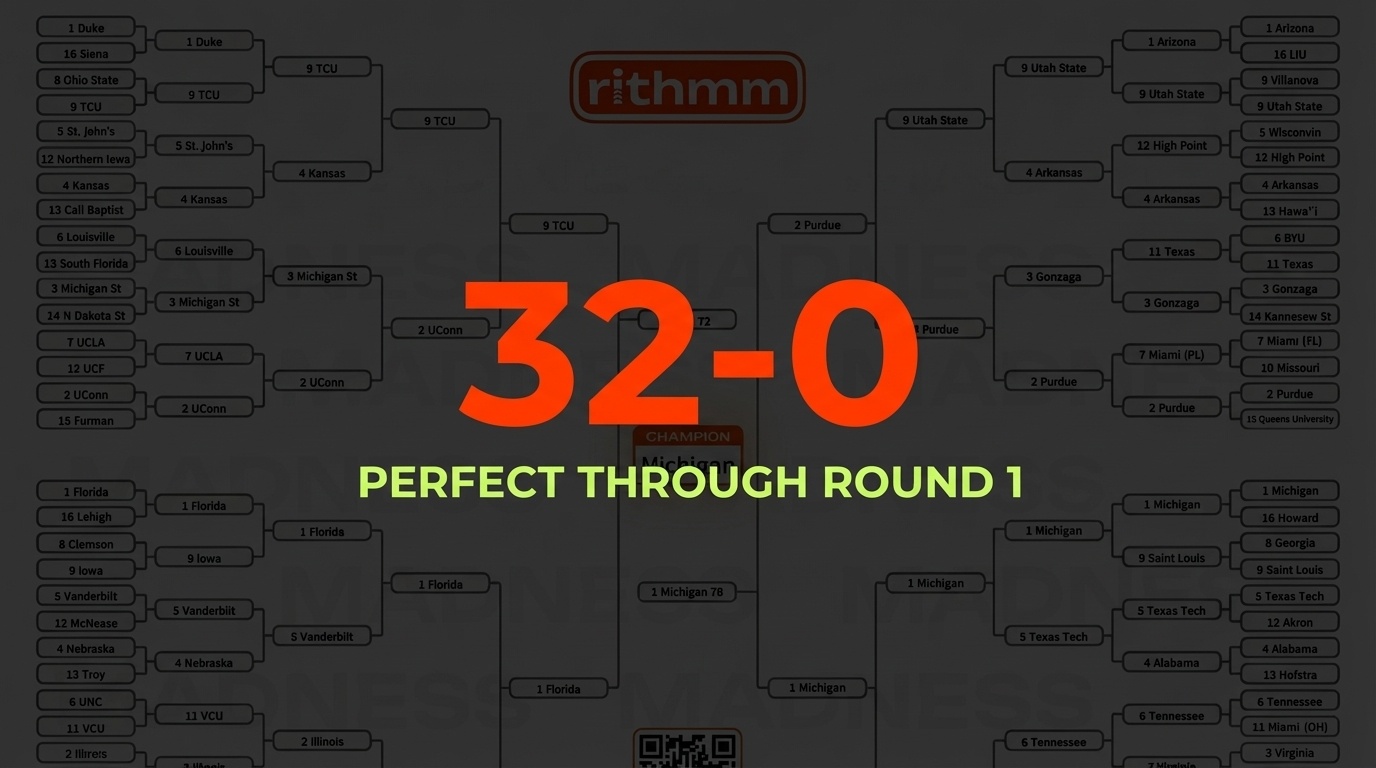


How to Pick a Smarter March Madness Bracket: What Rithmm's Data Says About Duke, Arizona, and 1-Seeds

March Madness is full of chaos, but smart bracket building isn't about picking random upsets and hoping for the best.
It's about understanding where the tournament stays chalky, where it opens up, and which teams consistently appear deepest in strong bracket outcomes.
Rithmm's bracket data makes this clearer than most people expect.
Looking across bracket distributions around the national championship, one matchup stood out more than any other: Duke vs Arizona. That was the most common predicted championship pairing in the data — and it wasn't a close call.
The broader pattern is even more useful for anyone filling out a bracket this week: 1-seeds dominate the deepest rounds, especially when it comes to championship outcomes.
The biggest takeaway from Rithmm's bracket data
If you want to build a smarter March Madness bracket, start by respecting the top seeds.
Rithmm's data shows that 1-seeds heavily control the championship picture. In the championship seed distribution, 1-seeds accounted for 61.8% of title winners in the brackets analyzed.
That's a massive signal — and one most casual bracket players ignore. People love a Cinderella story. They talk themselves out of the strongest championship foundation trying to look smart. The title usually lives closer to the top.
Duke vs Arizona was the most common championship matchup
One of the most interesting findings in the data is that Duke vs Arizona showed up more than any other national championship pairing.
That matters because it shows how strong bracket logic clusters around certain teams. When one matchup rises above the rest, those teams are consistently surviving multiple bracket paths — not showing up because of one-off hot takes or recency bias.
If you're building your bracket around probability rather than narrative, this is the kind of signal worth anchoring to.
The most common predicted champions
The winner distribution adds another layer. The team that showed up most often as the predicted national champion was Duke. Other top title picks in the data:
Florida
Arizona
Michigan
UConn
Houston
The best bracket logic isn't spreading title equity randomly across the field. It's concentrating around a tight group of high-ceiling teams — and the data reflects that.
What this means for your bracket strategy
A lot of casual players build brackets backward. They start by trying to look clever — a shocking Final Four, a 10-seed in the Elite Eight, a wild title pick nobody else has. It feels fun. It's usually not optimal.
Rithmm's bracket data points to a better framework:
1. Start with a strong title core
The championship data leans heavily toward elite teams and top seeds. If 1-seeds are winning the title in 61.8% of bracket outcomes, your bracket should respect that.
2. Be selective with chaos
Upsets matter in March Madness, but not every round should be treated like an upset festival. The deeper the tournament goes, the more bracket strength tends to consolidate around better teams.
3. Differentiate in the middle, not at the top
A lot of players try to get unique by making a strange national champion pick. A better move is often to keep your title game strong and create separation in the Sweet Sixteen or Elite Eight.
4. Use probability, not vibes
If a matchup like Duke vs Arizona keeps surfacing as the most common title path, that is worth more than a social media narrative built around one hot team.
Why 1-seeds dominate March Madness brackets
The most powerful insight here isn't the Duke vs Arizona matchup. It's the dominance of the top line overall.
Rithmm's seed distribution by round shows that top seeds remain especially strong as the tournament narrows — controlling a massive share of championship outcomes even as lower seeds create first-weekend chaos.
Yes, there are upsets. Yes, lower seeds make runs. Yes, the first weekend gets weird. But when it comes time to cut down the nets, the strongest teams usually look like the strongest teams.
The bracket players who beat their pools year over year aren't the ones who predicted the most chaos. They're the ones who identified where probability was on their side — and had the discipline to follow it.
See what Rithmm's models are showing for this year's tournament. Start your 7-day free trial at rithmm.com.
Be sure to learn more about our March Madness AI Bracket Generator and Maker, too.