

The Best AI MLB Pitcher Prop Predictions: Where Real Edge Lives in Daily Baseball Betting
There are more than 2,500 player props available on a single MLB slate. Strikeout totals, hits allowed, walks issued, outs recorded, earned runs, total bases, home runs allowed. The volume is enormous, the lines move constantly, and the markets are some of the most inefficient in American sports betting. That's the structural setup, and it's why pitcher props specifically are where AI models find the cleanest, most repeatable edge in baseball every single night.
This is a look at why pitcher props are the most beatable daily bet in MLB, what Rithmm's AI is actually doing to find edge in those markets, and the real models' performance numbers that prove the approach is working.
Why Pitcher Props Are the Most Beatable Bet in MLB
A few structural realities make pitcher props uniquely vulnerable to a model-driven approach.
The first is volume. Books post hundreds of pitcher prop lines every day, every starting pitcher gets four to six different prop types, and the markets get less attention per line than game lines or marquee player props. Books can't sharpen every number. Some lines sit at opening prices for hours because not enough action is moving them. That's where the edge opens up.
The second is data depth. Pitcher performance is one of the most data-rich domains in all of sports. Every pitch is tracked. Spin rate, release point, exit velocity off the bat, swing-and-miss rate, called strike rate, batter handedness splits, pitch sequencing tendencies. The signal-to-noise ratio in pitcher data is higher than almost any other measurable thing in baseball, which means a real model has a lot to work with that public bettors mostly aren't processing.
The third is public-money distortion. Casual bettors hammer the strikeout overs on big-name pitchers because the narrative is "ace equals lots of strikeouts." Books shade those lines accordingly. But strikeout production is matchup-specific in ways the public almost completely ignores. A pitcher facing the team with the highest contact rate in baseball is not the same pitcher he was four days ago against a team that whiffs at the league's worst rate. The models know that. The public bets the name.
The fourth is line variance across books. Pitcher prop lines vary book to book by half a strikeout, a quarter of a walk, a tenth of an inning. That kind of variance does not exist on a Sunday Night Football moneyline. It is rampant on pitcher props every single night, which means even a moderate model edge gets amplified when you're shopping the right lines.
That's the entire structural case for why pitcher props are where the daily MLB edge lives. The market is loud, deep, and inefficient. The models are built to find the gaps.
What Rithmm's AI Is Reading on Pitcher Prop Lines
Every pitcher prop Rithmm's models produce runs through the same opponent-adjusted, situation-aware AI that powers every sport in the app. For pitchers specifically, the models are processing:
Opponent-adjusted strikeout rate by lineup composition and handedness. A pitcher's season K/9 means something against a league-average lineup, and almost nothing against a specific lineup with a specific platoon split that night. The models recalculate strikeout expectation against the actual lineup the pitcher is facing.
Pitch arsenal usage against the matchup. Which pitches the starter relies on, which batters in tonight's lineup struggle against those pitches specifically, and how lineup construction shifts the expected pitch mix. Some pitchers see their strikeout numbers crater against lineups with a few specific hitter types. Others stay consistent regardless. The models know the difference.
Walk rate adjusted for opponent plate discipline. This is one of the most underweighted signals in the entire MLB market. A pitcher's BB/9 looks like a fixed trait, but it's actually highly responsive to who he's facing. Patient teams draw more walks. Aggressive teams swing themselves out of walks. The walk line is set near the pitcher's average and rarely adjusts for matchup, which is exactly where edge accumulates.
Park factors and weather. Wind direction at Wrigley, altitude at Coors, foul territory at the Coliseum, humidity at loanDepot Park. The models bake ballpark and weather conditions into every projection, weighted to the specific impact each factor has on each pitcher's profile.
Game-script projections. A pitcher in a competitive game throws different pitches in different counts than a pitcher down 7-1 in the third inning. The models project expected game state and adjust pitcher prop expectations accordingly.
Recent form vs. season averages. In a 162-game season with starting pitchers throwing every five days, the last three to four starts often carry more signal than the season-long line. The models put elevated weight on recent performance, scaled by the strength of recent opponents.
The output is a projection for every pitcher prop on the slate, with an Edge percentage showing where the models' projection diverges from the market line.
The Proof: Rithmm's Pitcher Walks Model Performance
Here is what that approach actually produces on the most underweighted pitcher prop market in baseball.
On pitcher walks over bets specifically, Rithmm's models have hit at a 59.6% win rate across 225 bets this season. That's a 134-91 record, a 6.79% ROI, and a profit of nearly $2,000 in standard unit sizing. The Edge percentage on those plays is +3.6%, which is the models' signal that the line itself is consistently mispriced in the over direction on this specific prop type.
A few things to be straight about with a sample like that.
225 bets is a meaningfully larger sample than most ROI claims you'll see in betting marketing. It is not a small streak. It is a multi-month track record across hundreds of independent decisions, each of which had real win/loss outcomes attached.
A 59.6% win rate on a market priced near -110 is a profitable rate that compounds quickly. The math is simple. At even money, you only need 52.4% to break even. Hitting 59.6% over a 225-bet sample puts the models meaningfully above the break-even line, and the 6.79% ROI reflects that.
The +3.6% Edge isn't huge in isolation. It is huge as a sustained signal across hundreds of bets, because edge is what compounds. A 3.6% edge maintained over thousands of bets is how serious sports bettors actually build long-term profit. It is also exactly the kind of structural mispricing that opens up when the public ignores a market like pitcher walks and the books don't sharpen the line aggressively because volume isn't there.
This is one prop type. It is one of dozens the models run every night.
How to Use Rithmm's MLB Pitcher Prop Reads
The smartest way to use the models on MLB pitcher props is not to bet every line they touch. It's to bet the lines where Edge is highest, the matchups where multiple signals align, and the books where the line variance is most favorable.
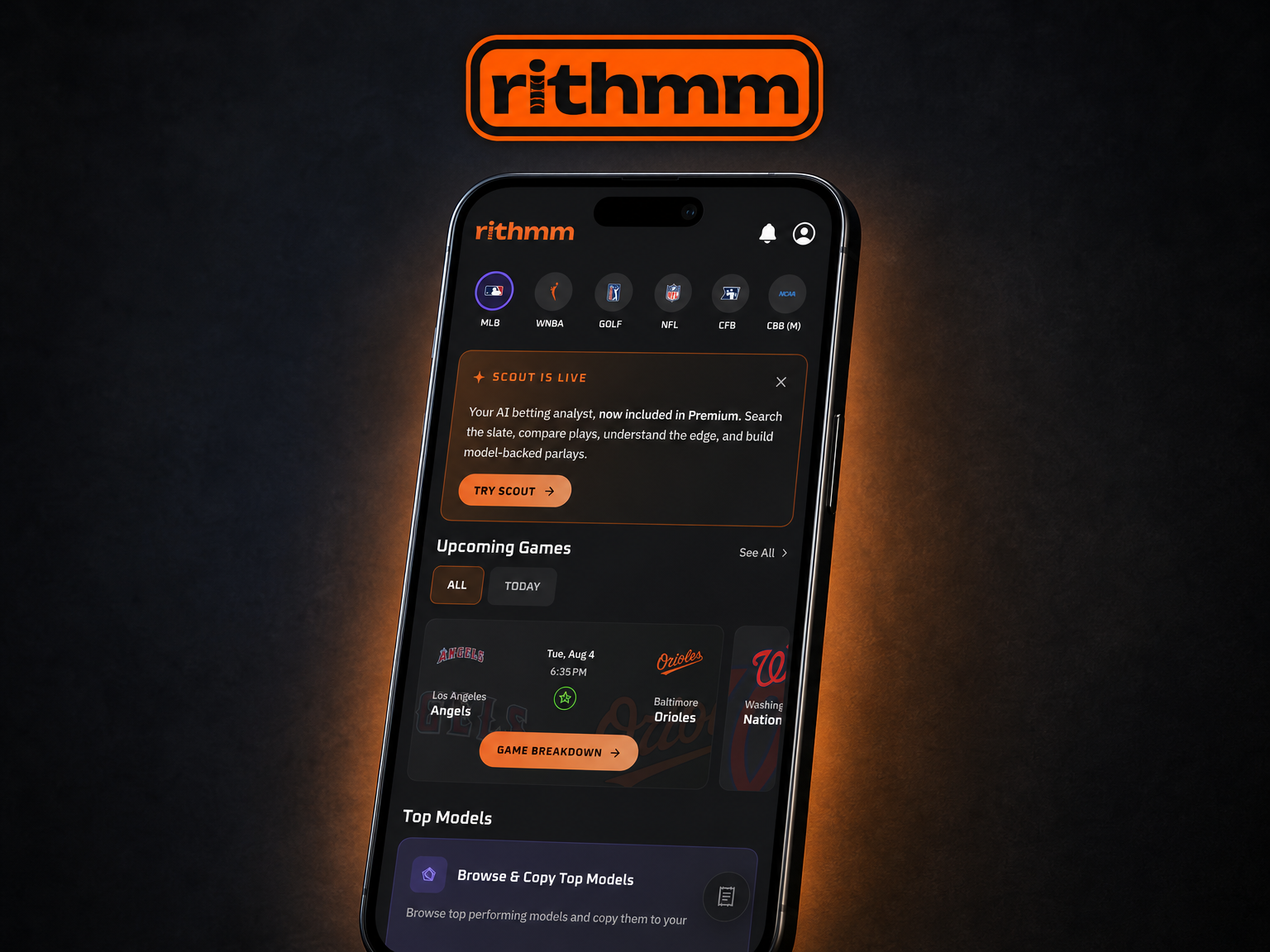
The Rithmm app surfaces every pitcher prop on tonight's slate with the models' projection, the market line, and the Edge percentage on each play. Strikeouts, walks, hits allowed, outs recorded, earned runs. The output is the same opponent-adjusted, situation-aware analysis on every prop type the books post.
For bettors who want a structured daily process instead of guessing on tonight's slate, MLB pitcher props are the most reliable place to start. The market is large enough to find value every single night, the models are built specifically to find structural inefficiencies in this category, and the proof is in the numbers.
Rithmm for MLB and Beyond
The full Rithmm subscription is $29.99 a month, and the AI models running every pitcher prop projection also run across seven other sports in the app: NFL, NBA, WNBA, PGA golf, World Cup soccer, college football, and NCAA men's basketball. That's year-round coverage of the biggest betting markets in the world, with predictions and Edge signals updating across every slate every day.
The 7-day free trial starts when you do. Download the Rithmm app, run the models against tonight's MLB pitcher prop slate, and see exactly where the data is pointing before the first pitch.
Pitcher walks model performance reflects 225 bets through the current MLB season. Past performance does not guarantee future results. Rithmm provides data-driven predictions for entertainment and informational purposes.